






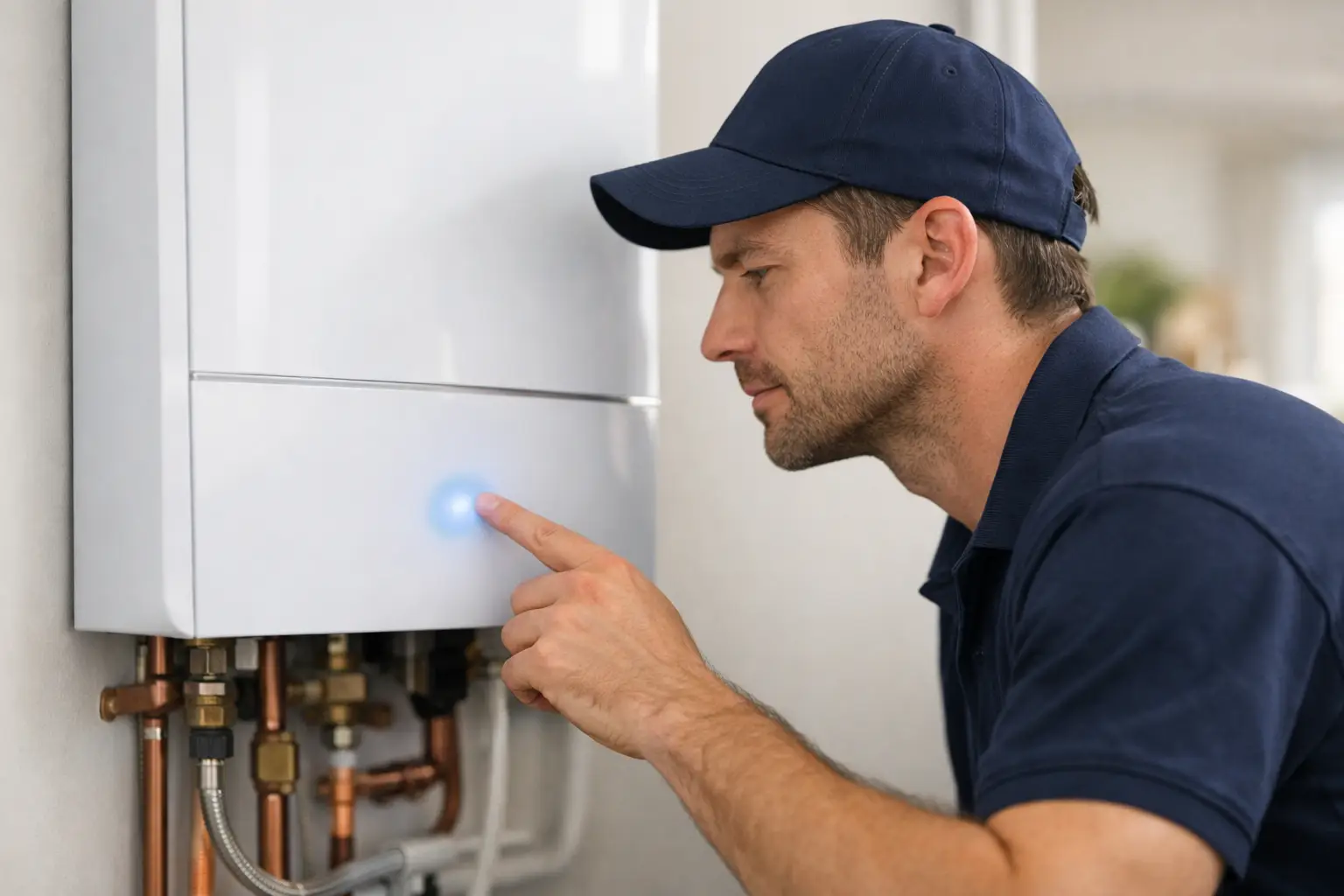
A Worcester boiler flashing blue light often means the boiler has gone into a fault or lockout condition and may need attention before it can provide heating or hot water. The exact meaning depends on the model and any code shown on the display, so check the instruction manual before pressing anything.
Get a fixed boiler quote online.
Quick answer: a flashing blue light is commonly linked to a failed ignition attempt, low system pressure, a condensate issue or another safety-related fault. If the boiler is old, repeatedly locks out or needs increasingly costly work, replacing it may be more sensible than continuing to spend money on it.
What does a Worcester boiler flashing blue light mean?
On many Worcester Bosch boilers, a flashing blue reset light indicates that the boiler has locked out. Lockout is a protective shutdown. The boiler has detected a condition that prevents it from operating safely, so it stops instead of continuing to attempt ignition.
However, Worcester boiler controls have changed over the years. Some models have a digital display, others use a reset button with an indicator light, and newer appliances may show a fault code alongside a symbol. A blue light alone does not provide enough information to diagnose the cause with certainty.
Start by identifying the full model name from the boiler case or installation paperwork. Then check whether a code, warning symbol or pressure reading appears on the display. This gives you a much clearer picture than the light colour alone.
Do not remove the boiler casing or try to access internal components. If you smell gas, suspect a gas leak or feel unwell with symptoms such as dizziness or nausea, turn off the gas supply if it is safe to do so, open doors and windows, leave the property and contact the National Gas Emergency Service on 0800 111 999.
Common reasons for a flashing blue light on a Worcester boiler
A flashing blue light can be triggered by several issues. Some are temporary, while others point to an ageing boiler that is becoming less dependable.
Low boiler pressure
Most sealed central-heating systems need pressure within the range shown in the boiler manual, commonly around 1 to 1.5 bar when the system is cold. If the pressure is too low, the boiler may stop working and display a warning or lockout indication.
A one-off pressure drop may be straightforward to resolve by following the manufacturer instructions. Repeated pressure loss is different. It can suggest an underlying issue and should not be ignored. If this has become a regular pattern on an older boiler, factor the reliability of the whole appliance into your decision.
Ignition or flame detection failure
The boiler must prove that it has lit correctly before it can run. If it cannot do that, it will shut down safely. This may happen after an interruption to the gas supply, but recurring ignition-related lockouts can be a sign that the boiler is reaching the stage where replacement deserves consideration.
A frozen or blocked condensate pipe
Modern condensing boilers produce condensate, which drains away through a pipe. During very cold weather, an external condensate pipe can freeze. A blockage can also prevent the boiler from operating normally.
Only follow the guidance for your exact boiler and avoid using boiling water or attempting work that you are not comfortable carrying out safely. If the problem continues, or the pipework arrangement is unsuitable, arrange professional advice.
Electrical, fan or sensor faults
A fault with the fan, controls, sensors or other internal safety components can also cause a lockout. These are not homeowner repairs. A single fault on a relatively new boiler may not justify replacement, but a history of faults on an older appliance can change the calculation.
Should you try resetting the boiler?
If the manual for your model says it is safe to reset after a lockout, you can normally try one reset using the stated procedure. On many Worcester boilers, this involves holding the reset control for a few seconds, but the method differs by model. Never guess the button sequence.
If the blue light stops flashing and the boiler resumes normal operation, keep an eye on it. If it locks out again, do not keep resetting it repeatedly. Repeated resets can mask a problem and leave you without heat or hot water at the worst possible time.
For landlords, a recurring lockout is also a practical warning. A boiler that is unpredictable between tenancies or during winter can create disruption for both you and your tenant. A planned replacement gives you more choice over the boiler, installation date and budget than an urgent failure does.
When a replacement may be the better option
A flashing blue light does not automatically mean you need a new boiler. The sensible choice depends on the boiler’s age, fault history, repair estimate, efficiency and how well it meets your household’s hot-water demand.
Replacement is worth considering when the boiler is beyond its expected working life, faults are becoming more frequent, parts are difficult to obtain, or the cost of putting it right is high compared with a new installation. It can also be the right time to replace when your home has changed – for example, after adding a bathroom or when a combi boiler no longer provides enough hot water for the household.
A new boiler is not simply a like-for-like purchase. The right type matters:
- A combi boiler provides heating and hot water directly from the mains, without a separate hot-water cylinder. It can suit smaller and medium-sized homes with limited space and modest simultaneous hot-water demand.
- A system boiler works with a hot-water cylinder. It can be a better fit where two or more bathrooms may be used at the same time.
- A regular heat-only boiler is often appropriate where a property already has a traditional tank-and-cylinder arrangement or needs a more involved replacement planned around the existing system.
The boiler output also needs to suit the property. More kilowatts do not automatically mean better performance. A correct recommendation considers the number of bathrooms, radiators, incoming water flow, insulation, property layout and the way your household uses hot water.
What does a Worcester boiler replacement cost?
For a straightforward replacement in the same location, a new gas boiler installation commonly falls in the region of £2,000 to £4,500. More complex work can cost more, particularly if it includes changing boiler type, relocating the boiler, replacing significant pipework, upgrading controls, fitting a new flue route or dealing with an older system arrangement.
These are guide prices, not a confirmed quotation. The final cost depends on the chosen boiler model, warranty level, property details and the work needed to install it safely and correctly.
A clear boiler quote should explain what is included. This may cover the boiler, standard flue components, installation labour, system treatment where appropriate, controls, commissioning, registration and removal of the old boiler. It should also flag potential extras before work is agreed, rather than presenting them as a surprise on installation day.
At Smart Adapt, the online quotation process is designed to gather the property details needed to recommend suitable combi, system or regular boiler options. Postcode availability, property suitability and installation requirements must be confirmed before a fixed quote or installation is accepted.
Choosing a Worcester replacement boiler
Worcester Bosch remains a familiar choice for many UK homeowners, but the best model is the one that fits the property rather than the badge on the front. Compare the available outputs, physical dimensions, hot-water performance, controls and the manufacturer warranty for the exact model.
Warranty periods vary by product and may depend on correct installation, registration and manufacturer terms. Check the warranty that applies to the specific boiler in your quote, rather than relying on a headline warranty figure from a different model.
If you are comparing monthly payments, remember that finance is subject to status, eligibility and lender approval. It can help spread the cost of a planned replacement, but the total amount payable and terms should be clear before you proceed.
FAQs
Can I keep using my Worcester boiler if the blue light is flashing?
If the boiler is in lockout, it may not operate at all. Check the manual and any display code. Do not repeatedly reset it or attempt to bypass a warning light.
Does a flashing blue light always mean low pressure?
No. Low pressure is one possible cause, but ignition, condensate, sensor and other faults can trigger a lockout. The model and any displayed code matter.
Is it safe to reset a Worcester boiler?
Use the reset function only as instructed in your boiler’s manual. One reset may be appropriate after a temporary issue. If the fault returns, seek qualified advice rather than continually resetting the appliance.
How old is too old for a boiler to repair?
There is no fixed age, but boilers approaching or beyond 10 to 15 years old are more likely to have reduced efficiency, limited parts availability and recurring faults. Compare the repair cost with the value and reassurance of a new installation.
Can I replace my Worcester boiler with a different brand?
Yes. A replacement boiler does not have to be the same brand. The choice should be based on the property, hot-water demand, budget, available warranty and installation requirements.
How long does boiler replacement take?
A straightforward like-for-like boiler replacement can often be completed in one day. Conversions, relocations and more complex system changes can take longer. The timescale should be confirmed after the installation requirements are assessed.
A flashing blue light is frustrating, but it can also be a useful prompt to decide whether you want another short-term fix or a dependable heating setup planned around your home. Get a fixed boiler quote online.