






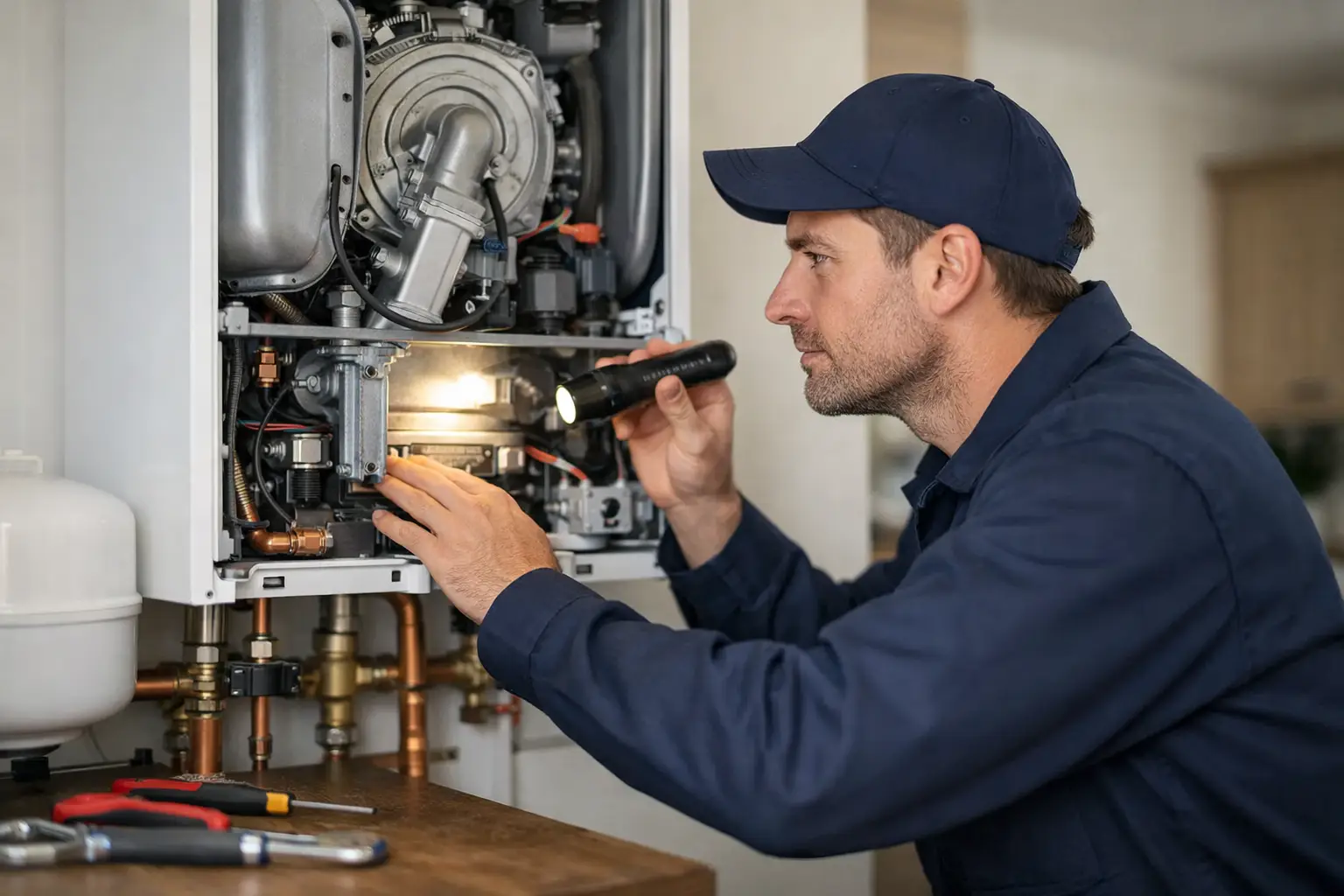
An annual boiler service checklist can help you spot when an ageing boiler is becoming a replacement decision rather than something to keep maintaining. It cannot diagnose a boiler or make it safe, but it can give homeowners and landlords a clearer view of reliability, running costs and what to do next.
Quick answer: keep a record of the boiler’s age, reliability, previous work, heating performance and hot-water demand. If it is breaking down repeatedly, parts are difficult to obtain, your needs have changed or replacement costs are becoming hard to justify, compare new boiler options before the next failure.
Get a fixed boiler quote online. Smart Adapt’s online journey helps you compare suitable combi, system and regular boilers using your property details, then confirms availability by postcode before an installation is accepted.
What this annual boiler service checklist is for
A service appointment is carried out by an appropriately qualified, Gas Safe registered engineer. This checklist is not a substitute for that work and should not involve removing a boiler case or attempting adjustments yourself.
Its purpose is more practical: to help you decide whether your current boiler still suits the home. A boiler can be working today while still being an uncertain choice for the next heating season. That is particularly relevant if you have had intermittent hot water, rising maintenance bills or a household that now uses more bathrooms than when the boiler was installed.
For landlords, clear records also make it easier to plan a replacement between tenancies rather than dealing with a failure at short notice.
Your boiler replacement checklist
1. Record the boiler’s age and model
Start with the make, model and approximate installation year. The data badge is often on or inside the boiler casing, but do not remove the outer case to find it. Your installation paperwork and warranty documents may also show the details.
Age alone does not decide whether replacement is needed. Some boilers continue to run reliably for many years, while others become costly much earlier. However, older models may have shorter remaining warranty cover and components can become harder to source. If you are regularly wondering whether a part can still be obtained, it is sensible to price a planned replacement.
2. Look at the pattern, not one isolated problem
One issue does not automatically mean a new boiler is the right answer. A relatively young boiler with a straightforward, one-off problem may still be worth keeping. The calculation changes when issues recur, particularly during colder months, or when separate parts have needed attention over a short period.
Write down the dates of any call-outs, what work was recommended and the cost. Compare the likely next expense with the value of a new installation, a fresh manufacturer warranty and a boiler sized for how you live now. A fixed replacement quote gives you a meaningful figure to compare, rather than relying on a rough estimate.
3. Check whether heating and hot water meet demand
Think about real daily use. Does the shower lose flow when another tap is running? Do radiators take a long time to warm up? Has an extension, loft conversion or additional bathroom changed the property since the boiler was selected?
A replacement is an opportunity to choose the right system, not simply fit the closest equivalent. A combi boiler provides heating and hot water from one compact unit and can suit many homes with one bathroom and moderate hot-water demand. A system boiler stores hot water in a cylinder, which can be useful where several people need hot water at similar times. A regular heat-only boiler is often considered where an existing traditional system and tanks are best retained.
The correct output depends on the home’s heat loss, radiator system and hot-water requirements. Bigger is not automatically better. Oversizing can add unnecessary cost, while undersizing can leave a busy household disappointed at peak times.
4. Review your energy use realistically
Compare recent energy bills and note whether your use has changed. Higher bills can have several causes, including tariff changes, insulation, household routines and the condition of the heating system. They do not prove that a replacement boiler will deliver a particular saving.
What a modern boiler can offer is current efficiency standards, improved controls compatibility and a warranty that starts from installation, subject to the manufacturer’s terms. The likely benefit depends on what it replaces and how the property is used. Be cautious of anyone promising a guaranteed saving without assessing the home.
5. Check the warranty position
Find your warranty certificate and confirm the start date, registration status and any conditions that apply. Manufacturer warranties vary by boiler model and may require registration within a set period and evidence that stated terms have been met.
If your current cover has ended, or is close to ending, that does not force a replacement. It does mean you should understand the financial risk if a significant component fails. When comparing new boilers, check the warranty for the exact model, not just the brand. Ask what is covered, how long cover lasts and what registration steps are required after installation.
6. Consider changes to the installation itself
Your checklist should include the boiler’s location and the wider system around it. Is the boiler in a place that is inconvenient to access? Are you considering a kitchen redesign, a conversion from a cylinder system to a combi, or replacement of an old back boiler?
These jobs can be very achievable, but they are not like-for-like swaps. Moving a boiler may require new pipework, a different flue route, condensate drainage, electrical alterations or making good after the work. A back-boiler replacement can involve removing old equipment and choosing a new position for the boiler. These details affect the final price and may require a survey or technical assessment.
What a replacement quote should make clear
An online quote can be quick, but it should be based on accurate answers about the property. State the number of bedrooms and bathrooms, current boiler type, fuel, location, hot-water cylinder where relevant, and any planned changes. Photos can also help identify access and installation requirements.
A useful quote should explain the proposed boiler and whether it is combi, system or regular. It should also set out the scope of installation, manufacturer warranty information, any agreed controls and the work included in the stated price.
Possible additional costs should be identified where they apply. Examples may include a boiler relocation, difficult flue arrangements, changes to pipework, cylinder removal or replacement, system upgrades, access constraints and remedial work found during assessment. The aim is not to create uncertainty. It is to make sure a fixed quote reflects the actual property rather than an assumption.
Installation time varies. A straightforward like-for-like replacement may be completed more quickly than a conversion, relocation or back-boiler replacement. Engineer availability, the complexity of the work and any survey findings also affect the date that can be offered.
Choosing the right time to replace
Planned replacement gives you more choice than an emergency decision. You can compare boiler types, consider where the unit should go and arrange a date around work or tenants. It can also avoid accepting the first available option when heating or hot water has failed.
That said, there is no benefit in replacing a reliable boiler purely because of its age. The strongest reasons are a repeated history of problems, uncertain parts availability, a major expected cost, an unsuitable hot-water setup or a change in the property’s needs.
For a landlord, it may also be sensible to schedule work in a void period where possible. Keep in mind that a replacement should be planned around the property and installation requirements, not simply the most convenient calendar date.
FAQs
Does an annual boiler service checklist tell me if I need a new boiler?
No. It helps you gather the information needed for a sensible decision. A qualified engineer must assess safety and technical condition, while a replacement quote can show what a suitable new system would cost.
Should I replace a boiler that is still working?
Possibly, but only where the wider picture supports it. Repeated issues, poor hot-water performance, expiring cover, difficult parts availability or a planned renovation can all make a proactive replacement reasonable.
Can I change from a regular boiler to a combi boiler?
Often, yes. Whether it is suitable depends on the property, water pressure, number of bathrooms and the household’s simultaneous hot-water demand. Removing tanks and a cylinder may also affect the installation scope.
How much does a new boiler replacement cost?
The confirmed price depends on the boiler selected and the installation work required. A like-for-like replacement is usually less complex than a relocation, conversion or back-boiler replacement. Provide full property details to receive a fixed quote rather than relying on a broad online price range.
Are warranties the same across all boiler brands?
No. Warranty length, coverage, registration requirements and conditions vary by manufacturer and model. Always check the exact boiler being quoted.
Can I spread the cost of a new boiler?
Finance options may be available, but they are subject to status, eligibility and lender approval. Check the term, representative example, total amount repayable and any conditions before deciding.
Who installs a replacement boiler?
Gas boiler installation must be carried out by a Gas Safe registered engineer. Your quotation should explain who manages the installation and the next steps before a date is confirmed.
If your checklist shows that your boiler is becoming a risk rather than a dependable part of the home, use the information to compare a properly matched replacement. Get a fixed boiler quote online.