






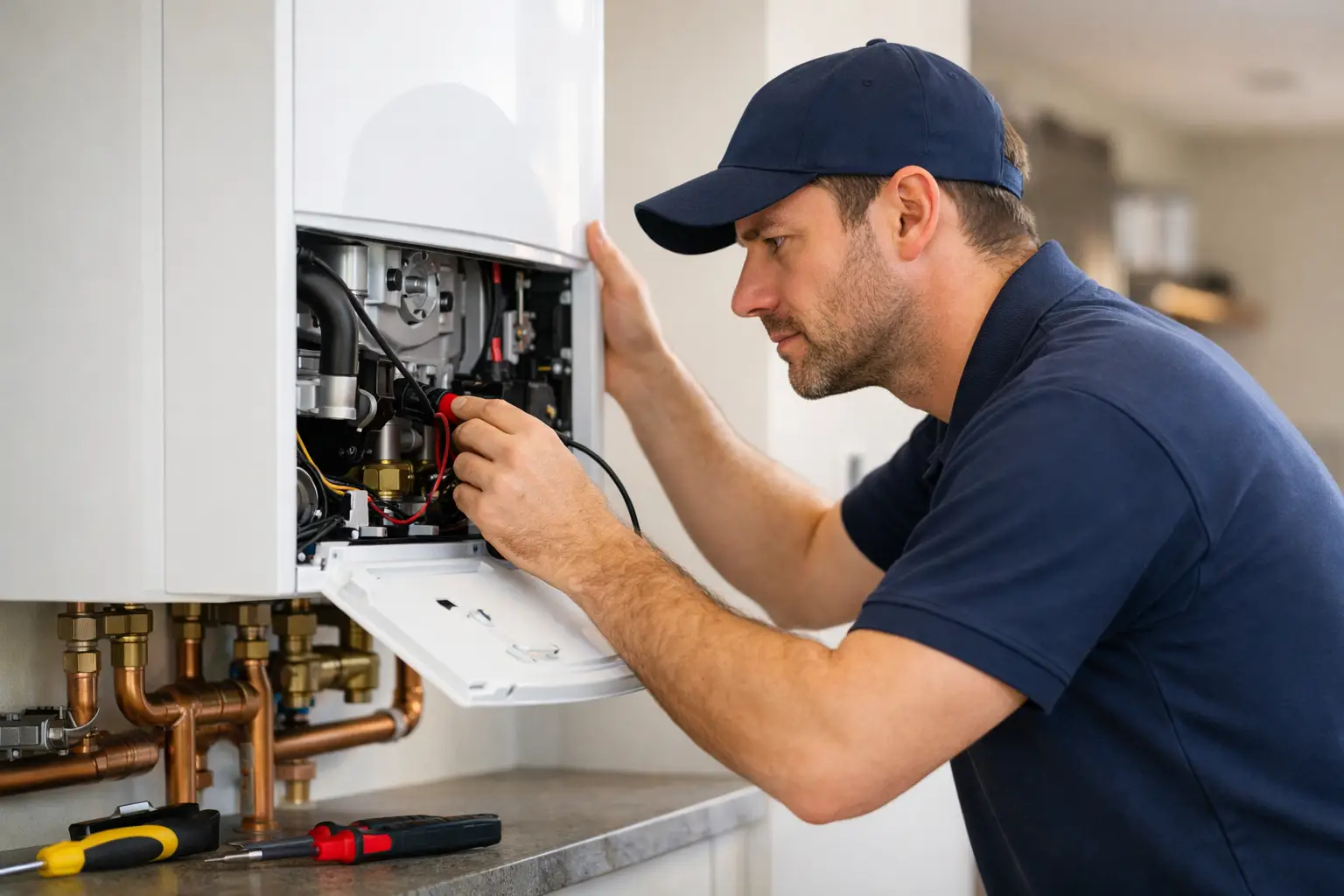
A Worcester Bosch display code can point to anything from low system pressure to an ignition or safety shutdown. Worcester boiler fault codes are useful clues, but the exact meaning depends on the boiler model and display. If the boiler is old, repeatedly locking out or becoming costly to keep running, replacement may be the more sensible long-term decision.
Get a fixed boiler quote online.
Quick answer: what should you do when a code appears?
Start by writing down the full code exactly as it appears, including any letters, and check the instructions for your specific Worcester Bosch model. Look for obvious safety concerns first: if you can smell gas, suspect carbon monoxide, or feel unwell with symptoms such as headache, dizziness or nausea, turn off the appliance only if it is safe to do so, leave the property and contact the relevant emergency service.
For a normal boiler lockout with no immediate danger, do not remove the casing or attempt work on gas components. A single code does not automatically mean you need a new boiler. However, frequent fault messages, an unavailable part, repeated loss of heating or hot water, and a boiler nearing the end of its useful life can all change the calculation.
Why Worcester boiler fault codes are not all the same
Worcester Bosch has produced many Greenstar boiler ranges over the years, including combi, system and regular models. Their displays, controls and diagnostic codes differ by generation. A code that appears on an older Greenstar CDi may not mean exactly the same thing on a newer Greenstar 4000, 8000 or model with a different controller.
That is why a photo of the display and the boiler’s exact model name are more useful than searching for a partial code online. The benchmark paperwork, boiler manual or data badge behind the front flap usually helps identify the appliance. If you are arranging a replacement quote, include these details along with clear photos of the boiler, flue position and surrounding pipework where possible.
Common messages and what they can indicate
Some Worcester Bosch fault messages are commonly associated with particular types of issue. They should be treated as general guidance rather than a diagnosis.
- EA or EA 227 is commonly associated with the boiler not detecting a flame after trying to ignite.
- E9 or E9 224 can relate to a safety temperature limit being reached.
- A low-pressure reading, rather than a formal fault code, may indicate that the sealed heating system needs attention. Many systems operate around 1 to 1.5 bar when cold, but follow the instructions for your own boiler.
- A reset or lockout message means the boiler has stopped to protect itself. Repeated resets are a sign to investigate the underlying cause rather than keep restarting it.
A code can arise from several causes, including an issue within the boiler, the system water pressure, the flue arrangement or the heating system itself. The safest route is always to use the manufacturer’s instructions and an appropriately qualified Gas Safe engineer where gas work is involved.
When a fault code may point towards replacement
An occasional issue on a relatively young boiler may be worth resolving. The decision is less straightforward when the same boiler has become unreliable. Homeowners and landlords usually start considering replacement when there is a pattern: heating drops out in winter, hot water is inconsistent, faults return after previous work, or the boiler is well beyond its warranty period.
Age matters, but it is not the only factor. A well-maintained boiler can continue to operate for years, while a newer appliance may still have a significant fault. Ask practical questions: is the fault isolated or recurring? Are the required parts available? Is the boiler correctly sized for the home? Has your household’s hot-water demand changed since it was installed?
Replacement can be particularly worth considering where an older boiler is paired with outdated controls, has limited warranty options, or is in a poor location that makes access difficult. A new installation also provides the opportunity to choose a boiler type that better suits the property rather than simply fitting a like-for-like model.
Choosing the right replacement boiler after repeated faults
The best replacement is not necessarily the highest-output boiler or the same model type you had before. It should match the property’s heat loss, number of bathrooms, radiators and usual hot-water demand.
Combi boilers for homes with modest hot-water demand
A combi boiler supplies heating and hot water directly from the mains, without a separate hot-water cylinder. It is often a practical choice for flats, smaller houses and properties with one bathroom, particularly where freeing up cupboard or loft space matters.
The trade-off is that a combi’s hot-water flow depends on the incoming mains-water supply and the boiler’s output. It may not be the right answer for a busy home where two showers are regularly used at the same time.
System boilers for stronger multi-bathroom demand
A system boiler works with a hot-water cylinder. It can be a better fit for larger homes and households that need stored hot water available at more than one outlet. The cylinder needs space, and the final recommendation depends on its size, location and the condition of the existing system.
Regular boilers where an existing tank-and-cylinder system suits the home
Regular, or heat-only, boilers work with a cylinder and usually feed and expansion tanks. They remain suitable for some older homes and properties with more complex existing arrangements. Keeping the same system type can sometimes reduce disruption, though a survey may show that a conversion is worthwhile.
A combi conversion, boiler relocation or back-boiler replacement usually involves more work than a straightforward swap. It can require changes to pipework, flue routing, water supplies, controls and the position of tanks or cylinders. These are exactly the details that should be identified before a fixed installation price is confirmed.
What a replacement boiler may cost
For planning purposes, a straightforward replacement boiler installation commonly falls in the region of £2,500 to £4,500. This is an estimate, not a fixed offer. The final cost depends on the chosen boiler and warranty, installation complexity, property layout and what work is required to bring the system up to the required standard.
Costs can rise where there is a conversion from regular to combi, a new flue route, difficult access, extensive pipework alterations, a back-boiler removal, or a need to relocate the boiler. Equally, a like-for-like replacement in an accessible position may be more straightforward.
A clear quotation should set out the boiler model, controls, proposed flue arrangement, system protection measures, commissioning and registration, as well as any assumptions or possible extras. At Smart Adapt, the online journey is designed to collect the property details needed to provide a fixed quote under confirmed terms. If more information is needed, a survey or technical assessment should happen before installation is accepted.
What happens if you choose to replace it?
Once your boiler and property details have been assessed, you can compare suitable combi, system or regular boiler options. The aim is to select an output and model that meets demand without paying for capacity the home does not need.
Installation times vary. A like-for-like replacement may often be completed in a day, while conversions, relocations and back-boiler replacements can take longer. A Gas Safe registered engineer should install, commission and test the boiler, explain the controls, and ensure the relevant product registration steps are completed. Warranty length and conditions depend on the exact manufacturer, model and registration requirements.
If you are considering spreading the cost, available finance options are subject to status, eligibility and lender approval. Compare the total amount payable as well as the monthly figure before deciding.
FAQs about Worcester boiler fault codes
Can I reset my Worcester Bosch boiler?
Follow the reset instructions in your specific boiler manual. If it locks out again, avoid repeated resets and arrange appropriate advice. A recurring lockout needs its cause identified.
Does EA always mean I need a new boiler?
No. EA is commonly linked with ignition or flame-detection issues, but it is not a replacement verdict. The boiler’s age, history, condition and the likely cost of resolving the problem all matter.
Is low boiler pressure a reason to replace the boiler?
Not by itself. Pressure can fall for several reasons. But if pressure loss is repeated alongside other faults on an ageing boiler, it is reasonable to compare the cost and disruption of further work with a planned replacement.
Can I find the meaning of a code from any Worcester Bosch manual?
Use the manual that matches your exact model. Different boiler generations can use different code formats and explanations.
How do I know whether a combi boiler is suitable as a replacement?
Consider the number of bathrooms, whether showers run at the same time, your incoming mains-water flow and the space available. A quote based on accurate property details can identify whether a combi, system or regular boiler is the better fit.
Will a new boiler come with a warranty?
Most new boilers include a manufacturer warranty, but the duration and terms vary by model. Registration, installation requirements and ongoing conditions can apply, so check the selected product’s current terms before proceeding.
Can landlords replace a faulty boiler between tenancies?
Yes. A planned replacement between tenancies can reduce disruption and help avoid an unexpected heating failure later. The right boiler still depends on the property layout and likely tenant hot-water demand.
A fault code is a useful warning, not a reason to rush into the wrong decision. If reliability has become a concern, compare a replacement that is properly matched to your home and the work required. Get a fixed boiler quote online.