






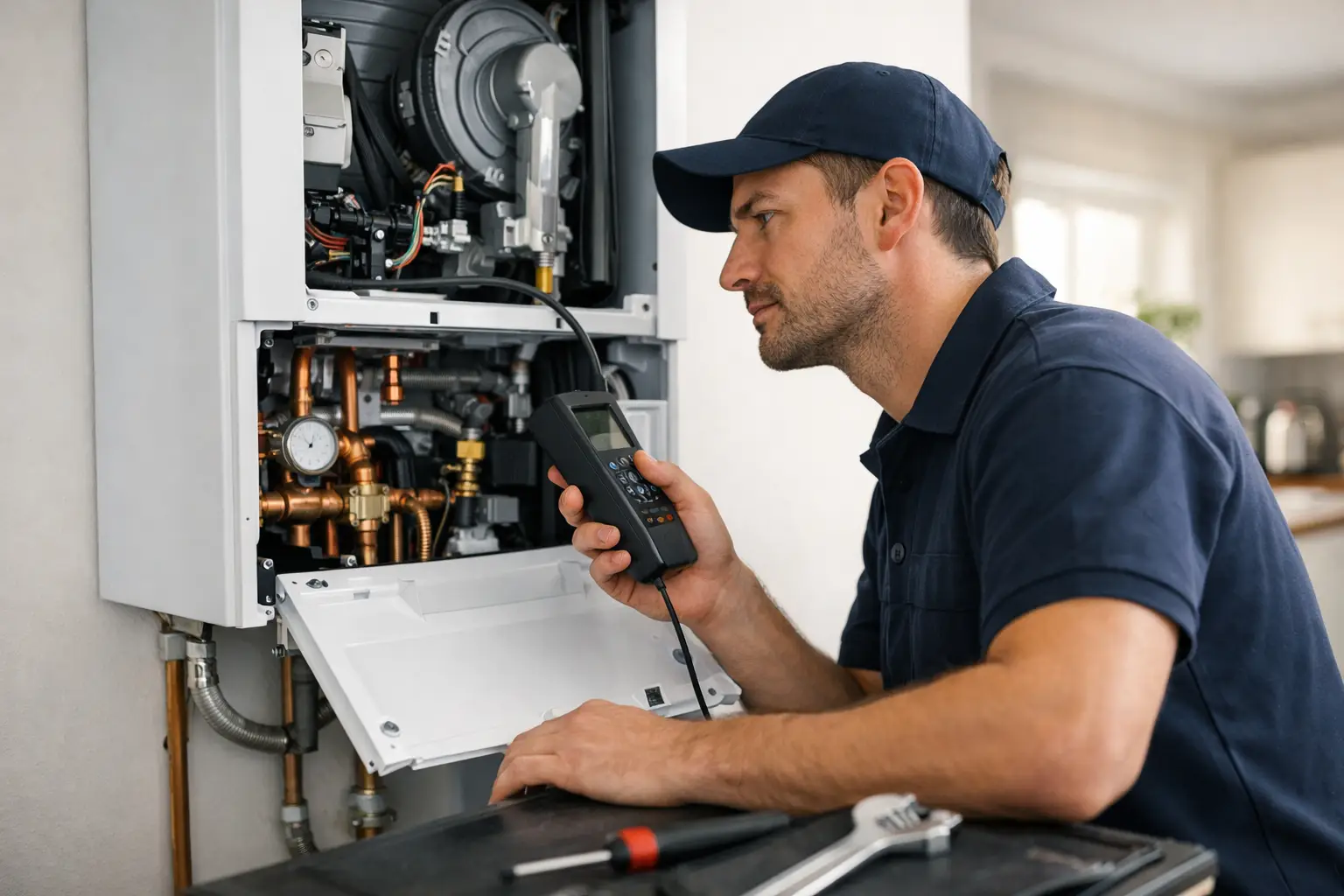
A Vaillant F28 fault means the boiler has tried and failed to ignite. It can be caused by a temporary gas-supply issue, but repeated F28 messages can also signal an ageing boiler that is becoming less dependable. If your boiler is older or faults are recurring, replacement may be the more sensible long-term decision.
Quick answer: reset the boiler once in line with its instructions, check whether there is an obvious gas-supply issue and act immediately if you smell gas. Do not remove the boiler case or attempt to diagnose internal components yourself. If the F28 fault returns, consider the boiler’s age, reliability and likely future costs before spending more on it.
Get a fixed boiler quote online.
What does a Vaillant F28 fault mean?
F28 is Vaillant’s ignition failure code. In simple terms, the boiler has not detected a successful flame after attempting to start. It will usually stop and display the code as a safety measure rather than continuing to try to fire.
The code does not identify one guaranteed cause. A temporary interruption to the gas supply can trigger it, as can an issue within the boiler’s ignition, combustion or control system. The correct diagnosis needs to be made by an appropriately qualified Gas Safe registered engineer.
For a homeowner or landlord, the key question is often not just, “Why has this happened?” but, “Is this boiler still worth keeping?” An isolated fault on a relatively recent boiler with a valid manufacturer warranty is different from another breakdown on a 12 to 15-year-old unit with a history of unreliable hot water or heating.
Safe checks before you consider replacement
Start with safety, not a reset button. If you can smell gas, suspect a gas leak or feel unwell, do not operate electrical switches, smoke or use naked flames. Turn off the gas supply only if it is safe to do so, leave the property and contact the National Gas Emergency Service on 0800 111 999.
If there is no smell of gas or other immediate concern, check whether your gas meter has credit if you use a prepayment meter. You may also notice whether other gas appliances are working, but do not use this as a reason to interfere with the boiler or its gas controls.
You can reset the boiler once, following the instructions for your specific Vaillant model. A reset may clear a one-off interruption. Repeated resets are not a solution, particularly where the code returns shortly afterwards or the boiler will not remain running.
Avoid removing the boiler casing, touching internal parts or trying internet fixes involving electrodes, valves or the gas supply. Those parts affect combustion safety and are not homeowner adjustments.
When an F28 fault points towards a new boiler
An F28 code alone does not automatically mean replacement is necessary. However, it can be the moment when an older boiler’s overall condition becomes impossible to ignore.
Replacement deserves serious consideration when the boiler is beyond its original warranty, has had several faults in recent years or leaves the household without reliable heating and hot water. It may also be the practical option where parts are difficult to obtain, a diagnosis identifies several worn components, or the expected work is expensive relative to the age and condition of the appliance.
There is no universal cut-off point. A well-maintained boiler may be worth retaining after one issue, while a younger boiler can still be unsuitable if it has persistent problems. Think about the whole picture: breakdown frequency, the disruption to your home or tenants, likely cost, efficiency, noise and whether the boiler still meets your hot-water demand.
For landlords, an unreliable boiler can mean urgent calls, void periods and pressure to restore heating quickly. For owner-occupiers, the trade-off is usually between an uncertain sequence of future costs and the higher upfront cost of planned replacement with a new warranty.
Choosing the right replacement after a Vaillant F28 fault
A like-for-like boiler swap is often the simplest route, but it is worth checking whether the existing boiler type still suits the property. The best choice depends on the number of bathrooms, how many people use hot water at the same time, radiator demand and the available space for a cylinder or boiler.
Combi boilers for smaller and medium-demand homes
A combi boiler provides heating and hot water from one compact unit. It does not normally need a separate hot-water cylinder, which makes it popular in flats, smaller homes and properties with one main bathroom.
The most important figure for a combi is often its domestic hot-water output rather than its central-heating output. A higher-output model can provide a stronger flow at one outlet, but it does not make a limited incoming mains-water supply more powerful. A property assessment should consider that water supply before a model is chosen.
System boilers for homes with higher hot-water demand
A system boiler works with an unvented or vented hot-water cylinder. It can be a better fit where two bathrooms are used at similar times, or where a household wants stored hot water available for baths and showers.
It requires space for the cylinder and the installation can involve more work than a straightforward combi replacement. In return, it can offer a more suitable arrangement for larger homes and higher simultaneous demand.
Regular boilers where an existing system is suitable
A regular, or heat-only, boiler is often installed with a cylinder and separate tanks, although the exact arrangement varies. Retaining this boiler type can make sense where the existing system is appropriate, particularly in homes with traditional heating layouts.
Converting a regular boiler to a combi can free up cupboard or loft space, but it may require alterations to pipework, the hot-water system and electrical supplies. It should be priced after the property details are understood, not assumed to be the cheapest option.
What can a replacement boiler cost?
A supplied-and-installed boiler replacement commonly costs several thousand pounds, but an online estimate should never be treated as a confirmed price until the property details and installation requirements have been checked.
A straightforward combi-for-combi change in the same location will usually cost less than a conversion from a regular boiler, a boiler relocation or a back-boiler replacement. The selected boiler model, required output, flue route, controls, system upgrades and access all affect the final figure.
Possible additional costs can arise where the work needs new pipework, a condensate route, flue alterations, improved heating controls, electrical work directly required for the boiler installation, awkward access or changes to the existing heating system. A clear quote should explain what is included and flag work that depends on a survey or technical assessment.
New boiler warranties vary by manufacturer and exact model. They can also depend on correct installation, registration and the manufacturer’s terms. Do not choose a boiler on warranty length alone: suitability, output and installation quality matter just as much.
What happens when you request a Smart Adapt quote?
Smart Adapt’s online quotation journey is designed to gather the details that change a boiler price, including your property type, existing boiler arrangement, heating and hot-water needs and postcode. Availability is then confirmed for the relevant service area before an installation is accepted.
You can compare suitable combi, system and regular boiler options rather than being pushed into one model. Once the installation scope is confirmed, the work is carried out by Gas Safe registered engineers. A straightforward replacement can often be completed in a day, while conversions, relocations and more complex system changes can take longer.
Finance may be available for eligible customers, subject to status, lender terms and approval. It is a payment option to consider alongside the full cost of ownership, not a reason to select an unsuitable boiler.
FAQs about a Vaillant F28 fault
Can I keep resetting a Vaillant F28 fault?
Reset it once as instructed for the model. If the code returns, stop repeatedly resetting it and arrange for the cause to be assessed. Repeated resets can delay a proper decision about the boiler’s condition.
Does F28 always mean there is no gas?
No. It means the boiler has failed to ignite. A supply interruption is one possibility, but ignition and boiler-control issues can produce the same code.
Is a Vaillant F28 fault dangerous?
The boiler is designed to stop when it cannot confirm ignition. However, any smell of gas or suspected leak needs urgent action through the gas emergency service. Do not attempt internal work on the boiler.
Should I replace a boiler after one F28 code?
Not necessarily. One isolated event on a newer boiler may not justify replacement. The case becomes stronger if faults recur, the boiler is older, it has no useful warranty remaining or the expected costs are mounting.
Can I replace an old Vaillant with a different boiler brand?
Yes. A replacement does not have to be the same brand. The priority is a correctly sized boiler that suits the property’s hot-water demand, system layout and budget.
Will a new combi boiler suit a home with two bathrooms?
It depends on whether both bathrooms need hot water at the same time and on the incoming mains-water flow. A system boiler with a cylinder can be more suitable for higher simultaneous demand.
How do I get a confirmed price rather than an estimate?
Provide accurate property and system details during the quote process. The installation scope, postcode coverage and any technical requirements need confirmation before a fixed price can be offered.
A recurring F28 message is frustrating, especially when heating or hot water is needed. Rather than making a rushed choice after the next breakdown, use the fault as a prompt to assess whether a reliable, correctly specified replacement would give your home more certainty. Get a fixed boiler quote online.