






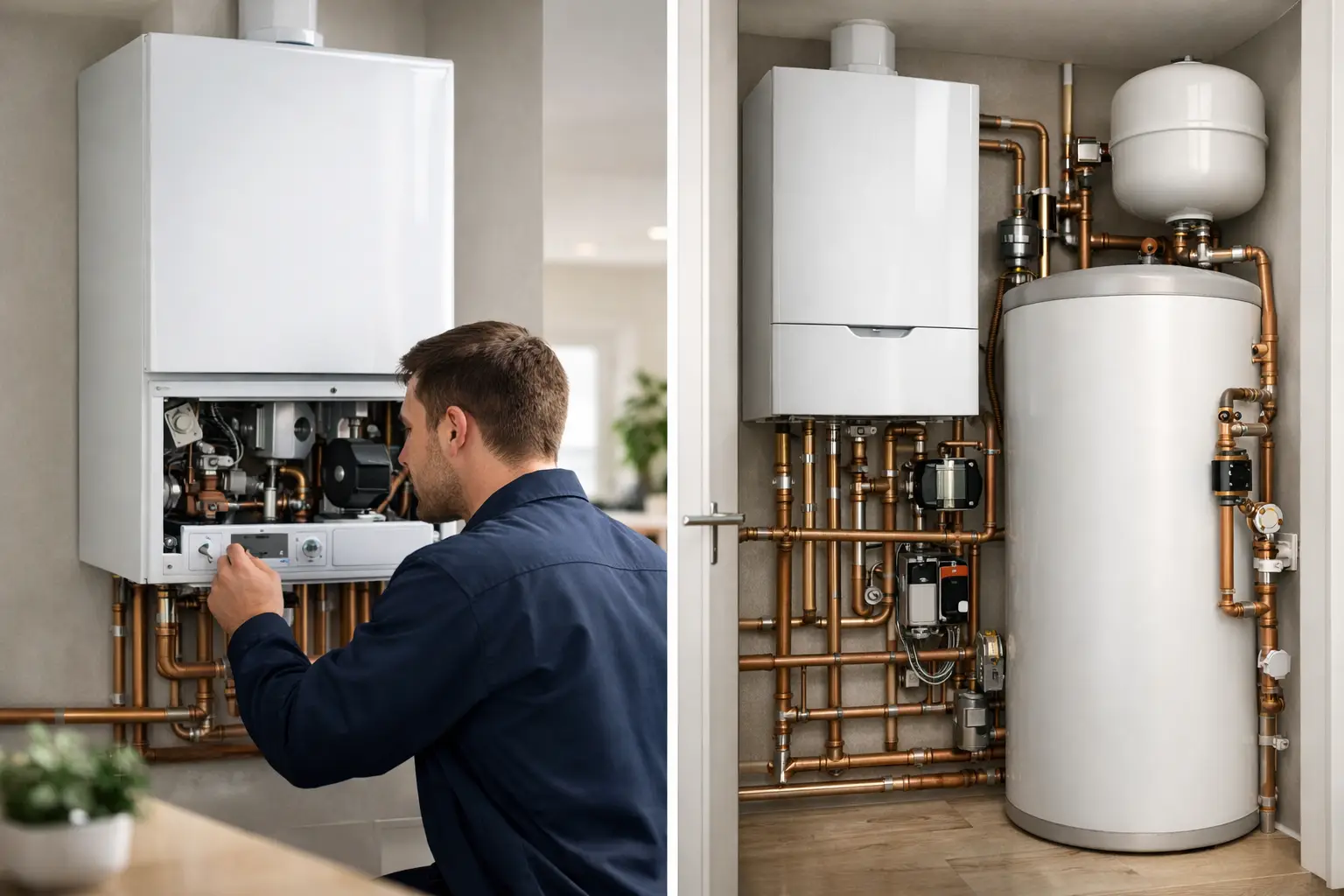
A combi boiler vs system boiler decision usually comes down to hot-water demand and available space. A combi suits many smaller homes with one bathroom, while a system boiler is often the better choice for larger households that use hot water in more than one place at once.
Quick answer: choose a combi for a compact, efficient set-up with mains-pressure hot water on demand. Choose a system boiler if your home has multiple bathrooms, high simultaneous demand or an existing hot-water cylinder worth retaining. The right answer depends on the property, not simply the boiler type.
Get a fixed boiler quote online to compare suitable options for your home, with clear information on the work included and any site-specific requirements.
Combi boiler vs system boiler at a glance
| Feature | Combi boiler | System boiler |
|---|---|---|
| Hot water | Heated on demand from the mains | Stored in a hot-water cylinder |
| Space needed | Usually only the boiler itself | Boiler plus cylinder, usually in an airing cupboard |
| Best suited to | Flats, smaller homes and one-bathroom properties | Larger homes and properties with two or more bathrooms |
| Multiple taps or showers | Flow can reduce when several outlets run together | Better at supplying several outlets, subject to cylinder capacity |
| Stored hot water | No | Yes |
| Installation complexity | Can be straightforward when replacing an existing combi | May be simpler where a cylinder is already in place |
Neither option is automatically better. A well-sized combi can be an excellent replacement in a three-bedroom home with one bathroom. Equally, removing a cylinder to fit a combi can be a poor trade-off where a busy family regularly runs two showers at the same time.
How a combi boiler works
A combination, or combi, boiler provides central heating and domestic hot water from one compact unit. When you open a hot tap or start a shower, the boiler heats water directly from the mains supply. There is no separate hot-water cylinder and, in most homes, no cold-water storage tank in the loft.
The main attraction is space. If you are replacing an older regular boiler with tanks and a cylinder, a combi conversion can free up useful cupboard or loft space. It also avoids heating and storing a full cylinder of water when you may only need a short shower or a few minutes at the kitchen tap.
Where combi boilers work well
Combi boilers are often a strong fit for flats, terraced houses, smaller family homes and rental properties with one main bathroom. They provide hot water whenever it is needed, rather than relying on a timed cylinder programme.
Mains water pressure matters. A combi can only deliver the flow available from the incoming mains, so a property with poor flow may not get the shower performance the homeowner expects. Boiler output also matters: a higher-output combi can improve hot-water flow, but it cannot create more mains pressure than the property receives.
The limits to consider
A combi has to divide its hot-water capacity between outlets. If someone starts a second shower while another is running, or opens a hot tap downstairs, the flow and temperature at the first shower can be affected. This is not necessarily a fault – it is a normal limitation of supplying hot water instantaneously.
There is also no stored reserve. During a water-supply interruption, there is no cylinder of hot water to use. For most households this is not a concern, but it is worth understanding before changing system type.
How a system boiler works
A system boiler heats your radiators and sends hot water to a separate, insulated cylinder. The cylinder stores a volume of hot water for baths, showers and taps. Many of the components needed for the heating system are built into the boiler, which can make it less complex than an older regular boiler arrangement, although the cylinder remains essential.
Because hot water is stored, a system boiler can serve more than one outlet at a time more comfortably than a combi. This makes it a practical option for homes with two bathrooms, an en-suite, a large bath or a household where morning showers overlap.
Where system boilers work well
A system boiler is commonly suitable for larger homes and households with regular, high hot-water use. It can also be the sensible replacement where the property already has a modern, well-sited cylinder and the family is happy with stored hot water.
Cylinder size and recovery time need to be matched to the household. A cylinder that is too small can run short after several showers; one that is much larger than necessary takes up space and may heat water that is not used. The installer should assess bathrooms, shower types, occupancy and typical patterns of use before recommending a capacity.
The limits to consider
The obvious compromise is space. You need room for the cylinder, normally in an airing cupboard, utility room or dedicated cupboard. System boilers also need the cylinder water heated in advance, usually using controls and schedules, although modern controls can make this straightforward.
Once the stored hot water has been used, the cylinder needs time to reheat. A correctly specified cylinder and boiler reduce the likelihood of this being an everyday issue, but it remains different from a combi’s on-demand approach.
Which boiler is right for your home?
Start with your real hot-water routine rather than the number of bedrooms. A two-bedroom home with one shower room will often suit a combi. A similar-sized property with one bathroom, one en-suite and two people showering before work may be better served by a system boiler.
A system boiler is also worth serious consideration if you have a high-flow shower, a large bath used frequently, or several people using hot water close together. Conversely, if the cylinder takes up valuable space and your household rarely uses more than one hot-water outlet at a time, a combi may be the more practical choice.
Your existing system affects the decision too. Replacing like for like is often less disruptive than changing boiler type. A conversion from a regular or system boiler to a combi can involve removing tanks and a cylinder, altering pipework, changing heating controls and assessing whether the gas supply and mains-water flow are suitable. Moving the boiler to a new location may also add work.
Installation cost: what changes the price?
There is no responsible one-price answer for every combi or system boiler installation. The boiler model and output are only part of the cost. A fixed quotation should make clear whether it includes the boiler, standard flue arrangement, controls, chemical system treatment, commissioning, registration of the warranty and removal of the old appliance.
Costs can increase where there is extensive pipework alteration, a difficult flue route, a boiler relocation, structural access work, upgraded controls, a new cylinder, or remedial work to an ageing heating system. Converting to a combi may involve decommissioning tanks and removing a cylinder. Replacing an existing system boiler while retaining a suitable cylinder can reduce the amount of alteration needed.
An engineer should also check radiator performance, existing pipework and system condition. Installing a new boiler onto a dirty or poorly maintained system without addressing the cause can affect efficiency, reliability and warranty requirements.
Do not choose on boiler type alone
The manufacturer, warranty terms, boiler output, controls and quality of installation matter as much as whether the boiler is a combi or system model. Warranties vary by model and may depend on correct installation, registration and ongoing servicing, so check the current terms supplied with your chosen boiler.
For gas boiler work, installation and commissioning must be carried out by a Gas Safe registered engineer. The completed installation should be tested, commissioned and explained to you, including how to use the controls and what to do if you notice a problem.
If you smell gas, suspect a gas leak or feel unwell from possible carbon monoxide exposure, do not investigate it yourself. Follow current Gas Safe emergency guidance, turn off the gas supply only if it is safe to do so, ventilate the property where possible, leave the area and seek urgent help through the appropriate emergency service.
A practical way to make the decision
Before requesting quotations, note how many bathrooms and showers you have, whether they are used at the same time, the location of your current boiler and cylinder, and whether freeing up cupboard space is a priority. If you are changing boiler type, expect the quotation process to ask more questions than a straightforward replacement.
Smart Adapt helps homeowners and landlords compare suitable boilers through a clear online quotation journey. Where applicable, you can begin with a £250 deposit and pay the remaining balance after installation under the agreed terms. Finance options may be available, subject to status and eligibility.
The most useful boiler is the one that fits the way your household actually uses hot water. Get a fixed boiler quote online, compare suitable boilers for your home and choose with the installation work, warranty and aftercare clearly explained.