






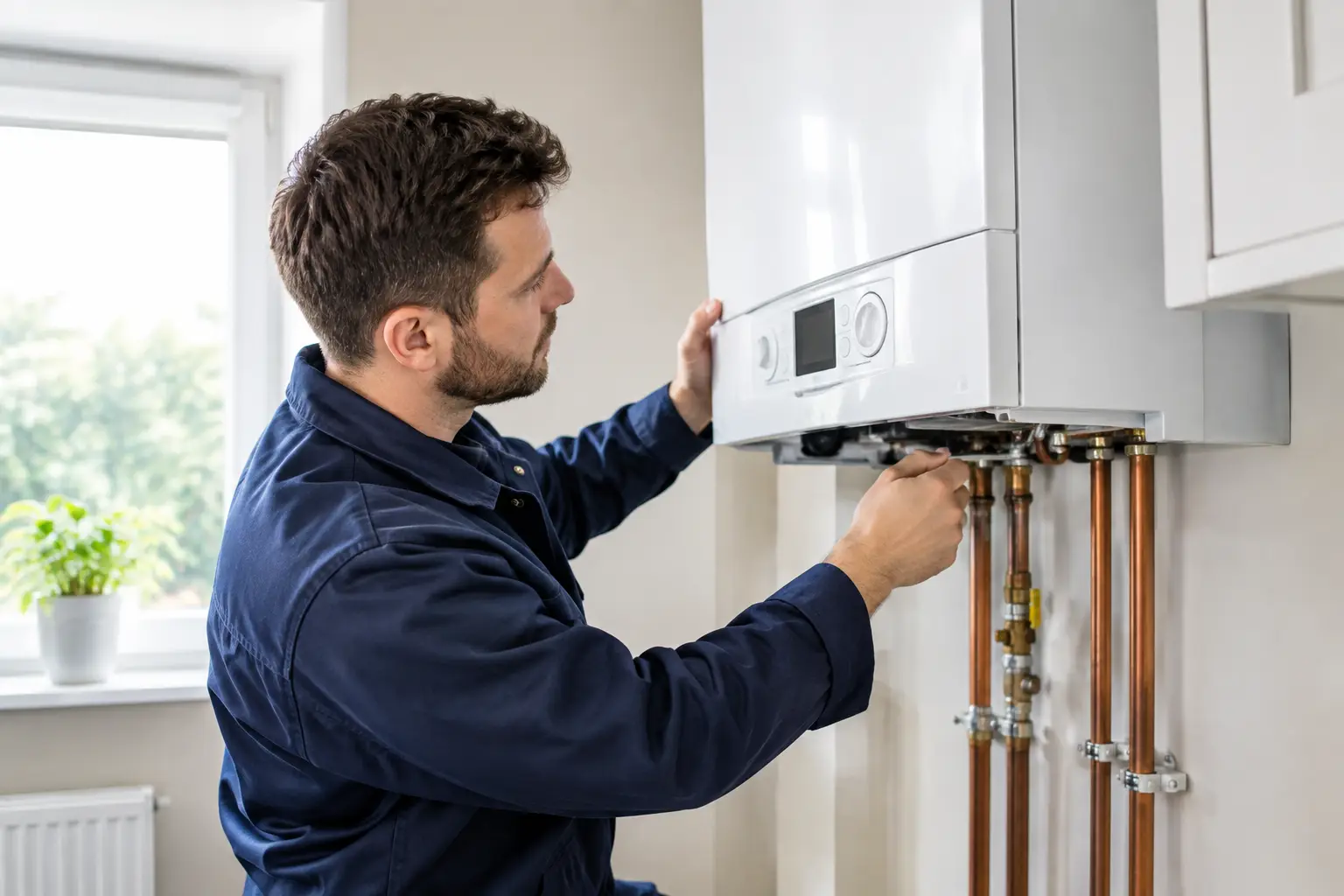
If your boiler is becoming unreliable, costly to keep running or unable to meet your hot-water demand, it may be time to replace it. The most useful boiler replacement warning signs are repeat breakdowns, rising energy use, inconsistent heating and an ageing model with limited parts support.
Quick answer: a single, minor issue does not always mean you need a new boiler. But when faults recur, repair costs mount up or your household has outgrown the system, replacement can be the more sensible long-term decision. Get a fixed boiler quote online.
1. Your boiler is around 10 to 15 years old
Age alone is not a reason to replace a working boiler, but it does change the decision. Older boilers can become less economical and more difficult to maintain as parts become harder to source. They may also lack the controls and efficiency standards expected from a modern condensing boiler.
If your boiler has worked reliably and still suits the property, there may be no need to rush. If it is old and beginning to fail, however, investing further money in it can be difficult to justify. This is particularly true for landlords who need dependable heating and hot water between tenancies.
2. Faults keep returning
An isolated fault can often be resolved without replacing the whole appliance. The stronger warning sign is a pattern: the boiler stops working, is attended to, then develops the same or a different problem again within a short period.
Repeated faults can mean several components are nearing the end of their useful life. Before approving another repair, consider the likely cost, the boiler’s age and whether a further failure would leave your household without heating or hot water. A replacement gives you a new manufacturer warranty, subject to the chosen boiler, registration requirements and the manufacturer’s current terms.
3. Heating or hot water is inconsistent
Radiators that take a long time to warm, hot water that runs hot and cold, or a boiler that struggles at busy times can indicate an ageing appliance or a system that no longer matches the household.
The cause is not always the boiler itself. Controls, system condition and demand all matter. Yet if the boiler is older and your family has grown, it is worth reviewing whether the type and output are still suitable. A combi boiler can work well in smaller homes with one bathroom and modest simultaneous hot-water demand. Homes with multiple bathrooms or regular overlapping showers may be better suited to a system boiler and hot-water cylinder. Some properties remain best suited to a regular heat-only boiler, especially where an existing tank-and-cylinder arrangement is practical to retain.
4. Your energy bills have risen without a clear reason
Energy prices and household use change, so a higher bill does not automatically prove that a boiler is inefficient. Compare similar periods where possible, and look at whether your heating habits or occupancy have changed.
An older non-condensing boiler or one that is no longer operating efficiently can use more gas to deliver the same comfort. A modern condensing replacement, correctly sized for the property and paired with suitable controls, may reduce wasted energy. Savings cannot be guaranteed because they depend on insulation, thermostat settings, tariff, weather and how the home is used.
5. The boiler is too noisy or performs poorly under demand
Banging, whistling, rumbling or frequent cycling are not sounds to ignore, particularly when paired with unreliable heating. They do not automatically mean replacement is essential, but they are a reason to assess the boiler’s condition and the likely cost of keeping it going.
Performance matters as much as noise. A boiler that cannot provide a comfortable shower while the kitchen tap is running may simply be the wrong size or type for the household. Choosing a larger boiler is not always the answer. Output should be matched to heat loss, radiator demand and hot-water use, rather than selected on a bigger-is-better basis.
6. You are planning a conversion, extension or major change in demand
A boiler that was suitable when installed may no longer be right after an extension, loft conversion or bathroom upgrade. Adding radiators or increasing the number of people using hot water can expose the limits of an older combi boiler.
This is also a good time to consider a change of boiler type. Moving from a regular boiler to a combi can free up space by removing tanks and, in some cases, a cylinder. The trade-off is that a combi has limits on simultaneous hot-water use. Retaining or installing a cylinder with a system boiler may be the better choice where several bathrooms are used at once.
Conversions and boiler relocations can cost more than a like-for-like replacement because pipework, flue routes, controls and alterations to the existing system may be needed. A proper quote should explain these requirements before work is accepted.
7. You have a back boiler or an obsolete setup
Back boilers, commonly found behind fireplaces, are often among the clearest boiler replacement warning signs. Replacement usually involves more than changing the boiler. The old appliance may need to be safely decommissioned, and a new boiler, flue and associated pipework installed elsewhere in the property.
This type of work needs a detailed assessment because access, the fireplace opening, gas pipe routing and the chosen new boiler location all affect the scope. It is rarely comparable with a straightforward boiler swap, so be wary of broad prices that do not account for the property.
8. You are concerned about safety
A boiler that appears damaged, produces soot marks, gives off an unusual smell or causes a carbon monoxide alarm to sound needs urgent attention. Do not attempt to investigate a suspected gas leak or carbon monoxide issue yourself. Turn off the gas supply only if it is safe to do so, leave the property, and contact the Gas Emergency Service on 0800 111 999. Call 999 if anyone has severe symptoms or is in immediate danger.
Once the immediate situation has been made safe, you can decide whether replacement is the right next step. Safety concerns should never be used as a sales opportunity, but an old or unsafe appliance may not be worth retaining.
What does a replacement boiler typically cost?
As a broad UK planning estimate, a straightforward like-for-like combi boiler replacement may often fall from around £2,000 to £3,500. A system boiler installation, regular-boiler replacement, conversion, relocation or back-boiler replacement can be more, often from around £3,000 upwards and potentially beyond £5,000 where the work is complex.
These are estimates, not confirmed prices. The final cost depends on the boiler brand and model, output, warranty level, flue position, controls, access, existing pipework and whether additional work is required. Removing a cylinder, changing boiler location, upgrading gas pipework or correcting unsuitable installation details can all affect the price.
A clear quotation should set out the selected boiler, main installation work, controls, warranty information and any identified extras. Smart Adapt manages the online quotation process and arranges installation by Gas Safe registered engineers. Postcode coverage, property suitability and engineer availability are confirmed before an installation is accepted.
When replacement is usually the better choice
Replacement is often worth serious consideration when the boiler is old, faults are recurring and the next repair would be expensive relative to the value of a new installation. It can also make sense when you need a different boiler type, more reliable hot water or a warranty for greater peace of mind.
There is no single rule for every home. A newer boiler with one isolated problem may not need replacing, while an older boiler that technically still works may be costly to run and unsuitable for your current needs. The right decision comes from looking at the property, demand and total likely costs rather than reacting to one inconvenience.
Frequently asked questions
How long does a boiler replacement take?
A straightforward, like-for-like replacement can often be completed in one day. More involved work, such as a conversion, relocation or back-boiler replacement, may take several days. Timescales should be confirmed once the installation requirements are known.
Is a combi boiler right for a three-bedroom house?
Possibly. Bedroom count is only part of the picture. The number of bathrooms, shower use, occupants and whether hot water is needed simultaneously are more useful measures. A three-bedroom home with one bathroom may suit a combi; one with two or more regularly used bathrooms may benefit from a system boiler and cylinder.
Can I replace a regular boiler with a combi?
Yes, in many properties, but it is a conversion rather than a straightforward swap. The existing cylinder and tanks may be removed, and pipework, flue arrangements and water supply must be assessed first.
Will a new boiler reduce my energy bills?
It may, particularly when replacing an inefficient older boiler, but savings vary. Your home’s insulation, heating controls, energy tariff and daily use all influence the result.
What is included in a fixed boiler quote?
This depends on the property and selected package. A useful quote should state the boiler model, installation scope, controls, flue work, warranty position and any assumptions or possible additional costs. A fixed price relies on accurate property information and confirmed installation terms.
Can I pay monthly for a new boiler?
Finance options may be available, subject to status, eligibility and lender approval. Check the amount repayable, term, interest rate and any deposit requirement before choosing a payment option.
If several of these warning signs sound familiar, the next step is not to guess at a boiler size or accept a vague estimate. Tell us about your property, existing system and hot-water needs, then Get a fixed boiler quote online.