






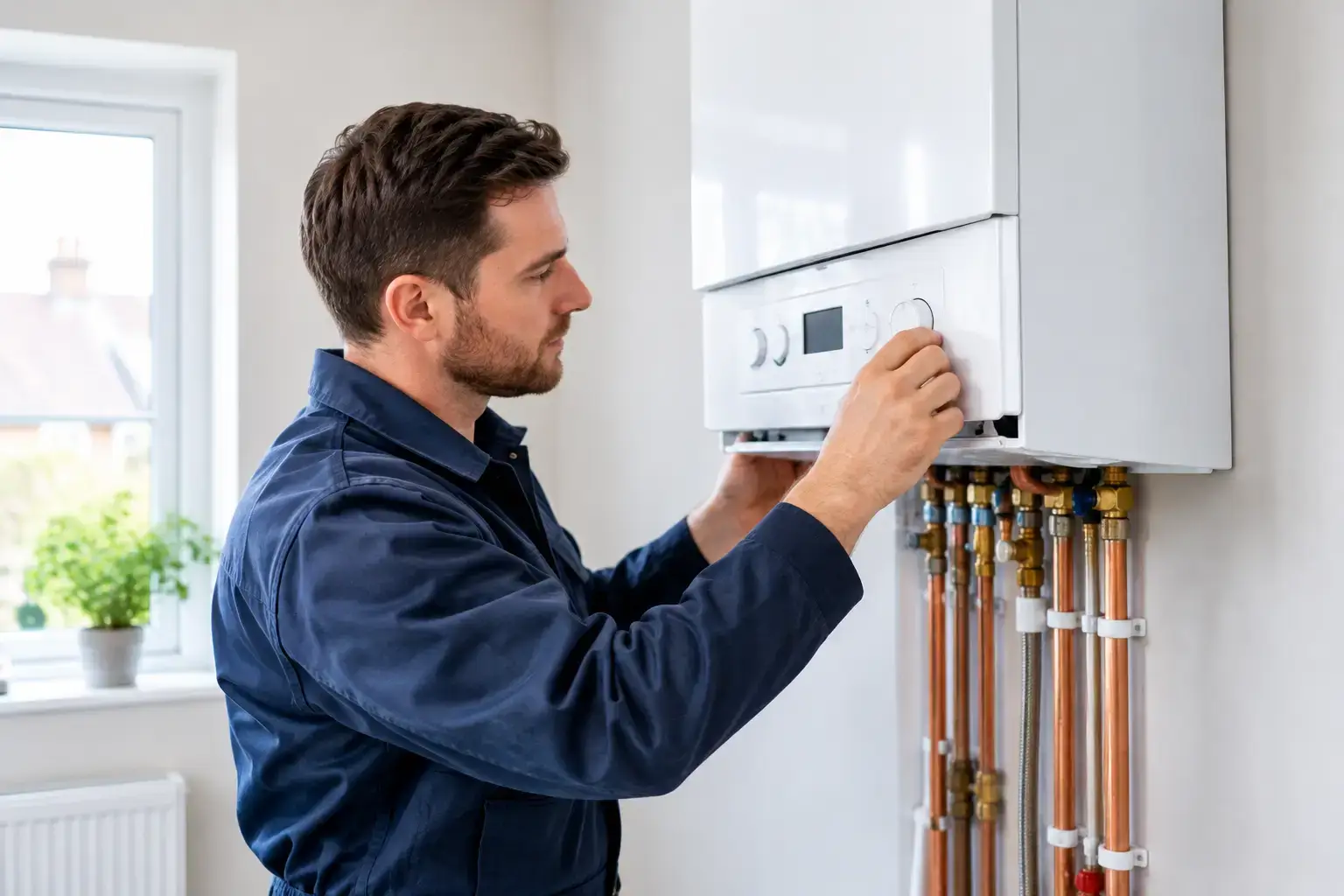
A typical boiler lifespan is around 10 to 15 years, but the right time to replace a boiler depends on its reliability, efficiency, repair history and whether it still suits your home’s heating and hot-water demand. An older boiler can continue working, but repeated problems and rising costs can make replacement the more sensible option.
Quick answer: A well-chosen modern boiler, correctly installed for the property, can provide dependable heating for many years. If your boiler is approaching or beyond 10 years old, needs frequent attention or leaves you without enough hot water, it is worth comparing replacement options before it fails completely.
Get a fixed boiler quote online.
What affects boiler lifespan?
Age is only one part of the picture. Some boilers work reliably beyond 15 years, while others become troublesome sooner because of installation quality, system condition, heavy demand or unsuitable sizing.
A boiler must be matched to the home. A small combi boiler may struggle in a busy family house with two showers in use at once. Equally, fitting an unnecessarily powerful boiler in a compact flat is not automatically better. The right output and boiler type help the system operate as intended and can avoid avoidable strain.
The condition of the existing heating system matters too. During a replacement, an installer will consider the pipework, radiators, controls, flue route and water quality. Where appropriate, system cleaning and protective measures may be needed to help protect the new boiler and meet manufacturer requirements. These details can affect the scope and price of installation, which is why a properly assessed quote matters.
How long should a new boiler last?
There is no guaranteed number of years. Manufacturers’ warranties vary by model and are subject to their terms, including registration and installation requirements. A long warranty can offer valuable protection, but it should not be treated as a promise that every part of the heating system will be covered indefinitely.
For most homeowners, a realistic expectation is that a quality replacement boiler should provide roughly a decade or more of useful service when it is suitable for the property and looked after in line with the manufacturer’s instructions. The practical question is not simply, “Has it reached a certain age?” It is, “Is this boiler still a reliable and sensible choice for this home?”
A landlord may reach that decision earlier if an ageing boiler creates avoidable disruption for tenants. A homeowner planning to stay put may prefer to replace before a winter breakdown forces a rushed decision. Neither approach is automatically right, but both can be reasonable.
Signs your boiler may be nearing the end of its useful life
A boiler does not need to stop working completely before replacement becomes worth considering. Watch for a pattern rather than a single isolated issue.
Frequent call-outs, parts that are difficult to obtain, inconsistent heating or hot water, unusual noises, and a growing repair bill can all point towards replacement. If the boiler is old and has become unreliable, spending more money to keep it going may offer only a short-term solution.
It is also worth considering whether your household has changed. Perhaps an extra bathroom has been added, more people now live at the property, or the hot-water demand is higher than when the boiler was installed. In that situation, an otherwise functioning boiler may no longer be the best fit.
For safety, if you suspect a gas leak or carbon monoxide issue, follow official emergency guidance and contact the appropriate emergency service or a Gas Safe registered engineer. Do not use replacement planning as a substitute for urgent safety action.
When replacement can make better financial sense
Replacing a boiler is a significant household purchase, so it is reasonable to compare the likely cost of keeping the existing appliance against installing a new one. A single minor issue on a relatively young boiler does not automatically mean replacement is necessary. However, the balance can change where repairs become recurring, expensive or uncertain.
A straightforward like-for-like boiler replacement often costs less than changing boiler type, moving its location or replacing a back boiler. As a broad guide, many standard UK replacement installations fall within the low-thousands, while more complex work can cost considerably more. The confirmed price depends on the property, selected boiler, flue requirements, controls, alterations and any work identified during the quotation process.
A fixed quote should clearly set out what is included and flag foreseeable extras. It should not rely on a headline price that ignores the condition or layout of your home.
Choosing a boiler that supports a longer working life
The best replacement is not necessarily the most expensive model or the one with the longest advertised warranty. It is the boiler that suits the property and is installed correctly.
Combi boilers
A combi boiler supplies heating and hot water directly from the mains, without a separate hot-water cylinder. It is often a practical choice for smaller homes with one bathroom and reasonable mains water pressure. It can save space, but its hot-water output needs to match demand. In larger households, simultaneous showers can be a deciding factor.
System boilers
A system boiler works with a hot-water cylinder. This can make it a strong option for homes with more than one bathroom or higher hot-water use, as stored hot water can be available at several outlets. It does require space for the cylinder.
Regular boilers
A regular, or heat-only, boiler is usually considered where a home already has a traditional heating and hot-water setup with tanks and a cylinder. Keeping a similar system can sometimes reduce disruption. Whether it is the right choice depends on the existing installation and the household’s needs, not simply the type of boiler already in place.
A good quotation process asks about bedrooms, bathrooms, current system layout, water demand and any planned changes. Smart Adapt uses property details to identify suitable options before confirming a fixed quote, rather than pushing every household towards one boiler type.
Installation choices that can affect lifespan and cost
A like-for-like replacement in the same location is often the simplest route. Moving a boiler to a different room, converting from a regular system to a combi, or replacing an old back boiler may involve additional pipework, flue work, electrical alterations and making good. These are not reasons to avoid a better long-term solution, but they do need to be allowed for upfront.
Most straightforward replacements can be completed quickly, often within a day. More involved conversions or relocations may take longer. Timescales should be confirmed once the property and proposed installation have been assessed, rather than assumed from an online starting price.
Professional installation by Gas Safe registered engineers is essential. On completion, you should receive the appropriate documentation, an explanation of the controls and details of the manufacturer warranty registration process. Keep these records safe, as they may be needed if you make a warranty claim later.
Can finance help with a boiler replacement?
Finance can make a new boiler more manageable by spreading the cost, but monthly payments are not automatically the cheapest route overall. Check the total amount payable, interest rate, term and any deposit requirement before deciding. Finance is subject to status, eligibility and lender approval.
For some households, paying upfront offers simplicity. For others, finance may help avoid delaying a necessary replacement. The right choice depends on your budget as well as the boiler and installation required.
Boiler lifespan FAQs
Is a 15-year-old boiler worth replacing?
It may be. Age alone is not enough to decide, but a 15-year-old boiler is more likely to have limited parts availability, lower efficiency and a higher risk of disruption than a modern replacement. Compare its reliability, likely repair cost and suitability for your home.
What is the average lifespan of a combi boiler?
A combi boiler commonly lasts around 10 to 15 years, though actual lifespan varies with the model, installation, system condition and hot-water demand.
Does a larger boiler last longer?
Not necessarily. Boiler output should be calculated around the home’s heating and hot-water requirements. Oversizing is not a shortcut to a longer-lasting installation.
Will a new boiler come with a warranty?
Most new boilers include a manufacturer warranty, but length and terms vary by brand and model. Registration, correct installation and other manufacturer conditions may apply. Check the exact warranty offered with your selected boiler.
Should I replace my boiler before it breaks down?
Planned replacement gives you more time to compare boiler types, models, warranty terms and installation options. If your boiler is unreliable or nearing the end of its likely working life, it can prevent a rushed decision during cold weather.
Can I change from a regular boiler to a combi?
Often, yes, but it depends on the property, water pressure, pipework and hot-water demand. A conversion can be more involved than a like-for-like replacement, so an accurate assessment is essential.
How do I know which boiler is right for my home?
Start with the number of bathrooms, household size, hot-water use, available space and existing heating system. A detailed online quote can narrow down suitable combi, system or regular boiler options before installation is arranged.
If your boiler is becoming unreliable, do not wait until you are left without heating to understand the alternatives. Get a fixed boiler quote online.