






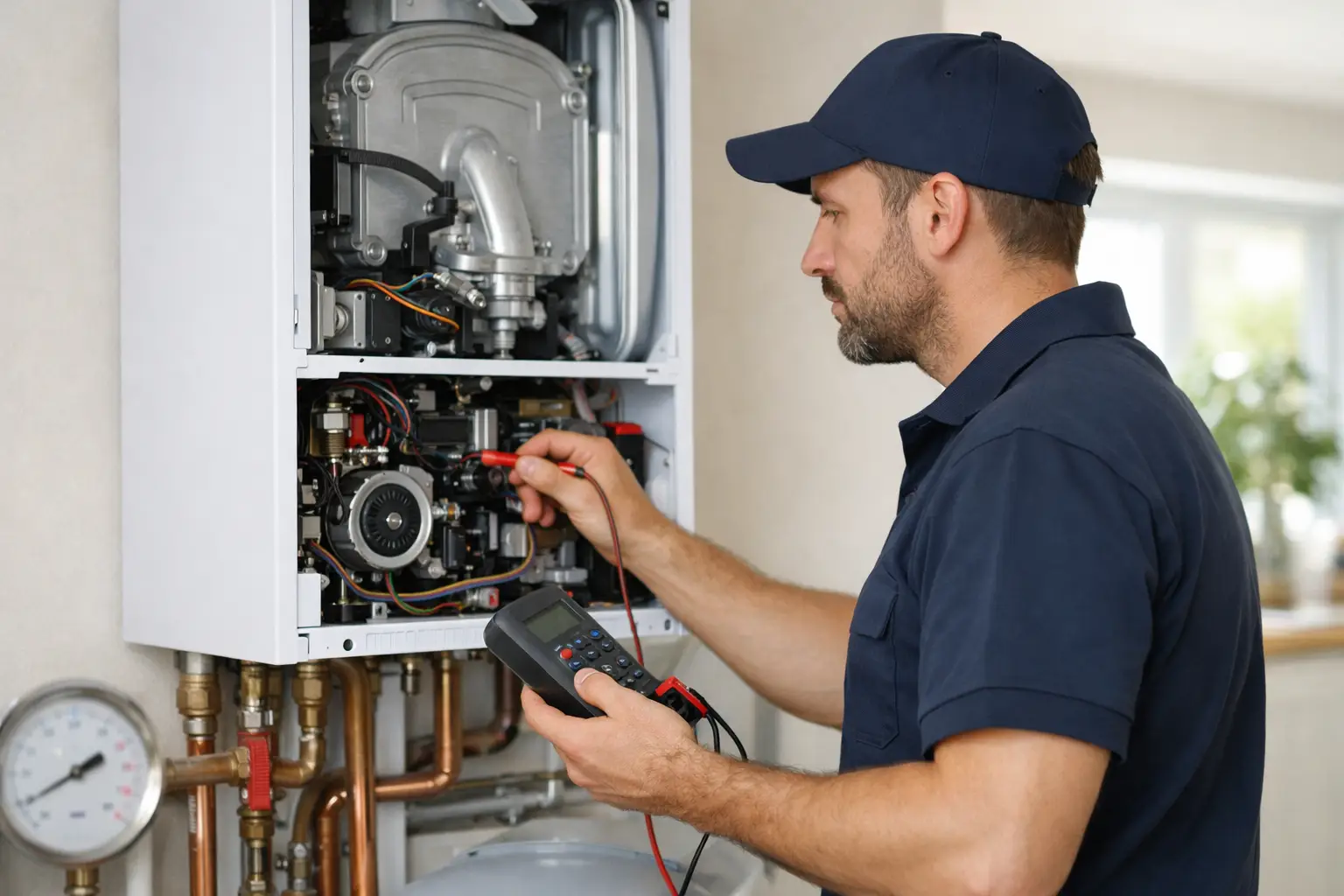
A Viessmann fault code identifies where the boiler has detected a problem, but it does not always tell you whether the boiler is economical to keep. If repeated codes, age or repair costs are becoming a concern, replacement may be the more sensible route. Get a fixed boiler quote online.
Quick answer on Viessmann boiler fault codes
Viessmann boiler fault codes are usually shown as a letter and number, or a number sequence, on the display. Their meaning depends on the exact boiler range, controls and age of the appliance. A code may relate to ignition, the flame signal, fan, condensate, water pressure, sensors or communication between components.
The safest first step is to record the code, check your boiler’s own user documentation and arrange appropriate professional advice where needed. Do not remove the casing or attempt to reset a fault repeatedly. If the boiler is older, has become unreliable or needs significant work, comparing the cost of replacement with the likely remaining life of the boiler can prevent further disruption.
Why the exact Viessmann model matters
A generic list of Viessmann boiler fault codes can be misleading. Viessmann has produced several generations of Vitodens boilers, alongside different system configurations and control units. The same-looking code can have a different meaning, diagnostic route or urgency on another model.
Before looking up a code, note the full model name from the boiler fascia or data plate, the code exactly as displayed and whether heating, hot water or both have stopped. Also note whether the code returns after a reset. This information is useful when assessing whether a replacement quote is appropriate, especially if you are already experiencing intermittent heating or hot-water failures.
Some display messages are status notifications rather than faults. Others put the boiler into a lockout to protect the appliance. A lockout should not be treated as a nuisance message to clear again and again. It is the boiler signalling that it has not completed an operating check safely.
Fault categories that can influence a replacement decision
A single fault on a relatively new boiler does not automatically mean it should be replaced. The decision changes when problems recur, parts are becoming harder to obtain, or the boiler is no longer right for the household’s demand.
Ignition and flame-related messages
Codes relating to ignition or flame detection can mean the boiler has not lit correctly or has not confirmed a stable flame. There can be several potential causes, so the code alone is not a diagnosis. Where this happens repeatedly, particularly on an older appliance, homeowners often start to consider replacement because an unreliable boiler can leave the property without heating or hot water at short notice.
If you smell gas, suspect a gas leak or feel unwell with symptoms that could indicate carbon monoxide exposure, leave the property if it is safe to do so and contact the relevant emergency service. Do not use the boiler again until it has been checked.
Pressure, circulation and water-related messages
A low-pressure reading may sometimes be visible alongside a fault code. While pressure can fall for straightforward reasons, repeated pressure loss needs proper investigation. It may point to a problem elsewhere in the heating system rather than the boiler itself.
For replacement planning, this matters because the installation quotation should consider the condition of the existing system. A new boiler needs clean, suitable system water and correctly designed pipework to operate as intended. Allowing for system cleaning, controls or necessary alterations at quotation stage is more useful than assuming every replacement is a simple like-for-like swap.
Fan, flue and condensate-related messages
Modern condensing boilers rely on a fan, flue and condensate route working correctly. A fault in these areas can prevent the boiler operating. These components are safety-critical, so they are not homeowner adjustments.
If your boiler is in an awkward location, has an older flue arrangement or regularly experiences condensate issues in cold weather, mention this during a replacement quotation. A survey may be needed to confirm the safest and most practical route for a new boiler and flue.
Sensor and electronic control messages
Temperature sensors, wiring and electronic boards help the boiler respond to heating and hot-water demand. On an older appliance, an intermittent electronic fault can be particularly frustrating because the boiler may work normally for days before failing again.
This is where replacement can make financial sense even when the boiler can technically be repaired. The choice depends on the boiler’s age, the likely cost of the work, warranty cover, the availability of parts and how much confidence you have in the appliance afterwards.
When is replacement more practical than another repair?
There is no fixed age at which every Viessmann boiler must be replaced. A well-maintained boiler may have useful life remaining, while another may be affected by repeat faults much earlier. The key question is whether spending more on the existing boiler gives you reasonable reliability.
Replacement is worth considering when the fault keeps returning, the boiler has several unrelated issues, a major component is involved, or the boiler no longer provides enough hot water for the household. Landlords may also prefer a planned replacement where reliability is becoming a concern, rather than managing a loss of heating during a tenancy.
A new boiler also gives you the opportunity to correct an unsuitable setup. For example, a smaller home with one bathroom may suit a combi boiler, which provides hot water without a cylinder. A home with two or more bathrooms used at the same time may be better suited to a system boiler with a hot-water cylinder. Properties with an existing traditional setup may remain best served by a regular heat-only boiler, depending on the system and available space.
What a replacement quote should consider
An accurate online quotation starts with clear property details. The number of bathrooms, radiators, occupants, current boiler position and type of system all affect the recommended boiler and installation scope. A boiler with a higher output is not automatically better. It needs to match the home’s heating requirement and, for combi boilers, its expected hot-water demand.
A confirmed fixed quote should explain what is included and identify potential extras before work is accepted. These may include moving the boiler, changing the flue route, upgrading controls, replacing a cylinder, converting from a regular boiler to a combi, or access work where the installation is more complex.
Many straightforward replacements can be completed in a day, but conversions, relocations and back-boiler replacements can take longer. Timescales depend on the existing system, pipework changes, flue position and any survey findings. The right approach is to set a realistic installation plan rather than promise a date before the technical details are confirmed.
Smart Adapt supplies and installs replacement combi, system and regular boilers through Gas Safe registered engineers in its confirmed service areas. Entering your postcode and accurate property information helps confirm availability, suitable products and any requirements specific to your home.
Warranty and payment considerations
Manufacturer warranties vary by the exact Viessmann model and may depend on the installation and product registration meeting the manufacturer’s current terms. Check the warranty offered on the boiler you are quoted, rather than relying on a general warranty length mentioned elsewhere.
If spreading the cost would help, finance options may be available, subject to status, eligibility and lender approval. Finance should be considered alongside the total installation scope, not simply the headline boiler price. A lower initial figure may not include the alterations your property needs.
FAQs about Viessmann boiler fault codes
Can I find my Viessmann fault code online?
You may find a possible explanation, but only use information that matches your precise model and documentation. Online lists are not a substitute for a proper assessment, particularly for ignition, flue, fan or gas-related messages.
Should I keep resetting a Viessmann boiler fault?
No. One reset may be permitted in the boiler’s user instructions, but repeatedly resetting a returning fault can mask an ongoing problem. Record the code and seek suitable advice.
Does a fault code mean I need a new boiler?
Not necessarily. One isolated fault may be repairable. Replacement becomes more compelling where faults recur, the boiler is older, costs are rising or the current system no longer suits the property.
Can I replace an old Viessmann boiler with a different brand?
Yes. The right replacement should be chosen around your home, hot-water use, system type, warranty and budget, rather than matching the existing badge. A quotation can compare suitable options.
Will a new boiler fit in the same position?
Often it can, and a like-for-like position can reduce disruption. However, flue clearances, access, condensate drainage and the condition of existing pipework must be checked first.
Can a combi replace a regular boiler and cylinder?
It can in some homes, particularly where hot-water demand is modest and there is suitable mains water flow. Homes with multiple simultaneous showers may be better keeping a cylinder with a system boiler.
What happens after I request a quote?
Your property details are reviewed to identify suitable boiler options and likely installation requirements. Where necessary, further information or a survey can confirm the final scope before an installation is arranged.
A fault code is useful evidence, but it should not force a rushed choice. If your boiler is becoming unreliable, use it as the prompt to assess the whole system, the demands of your household and the value of a properly specified replacement. Get a fixed boiler quote online.