






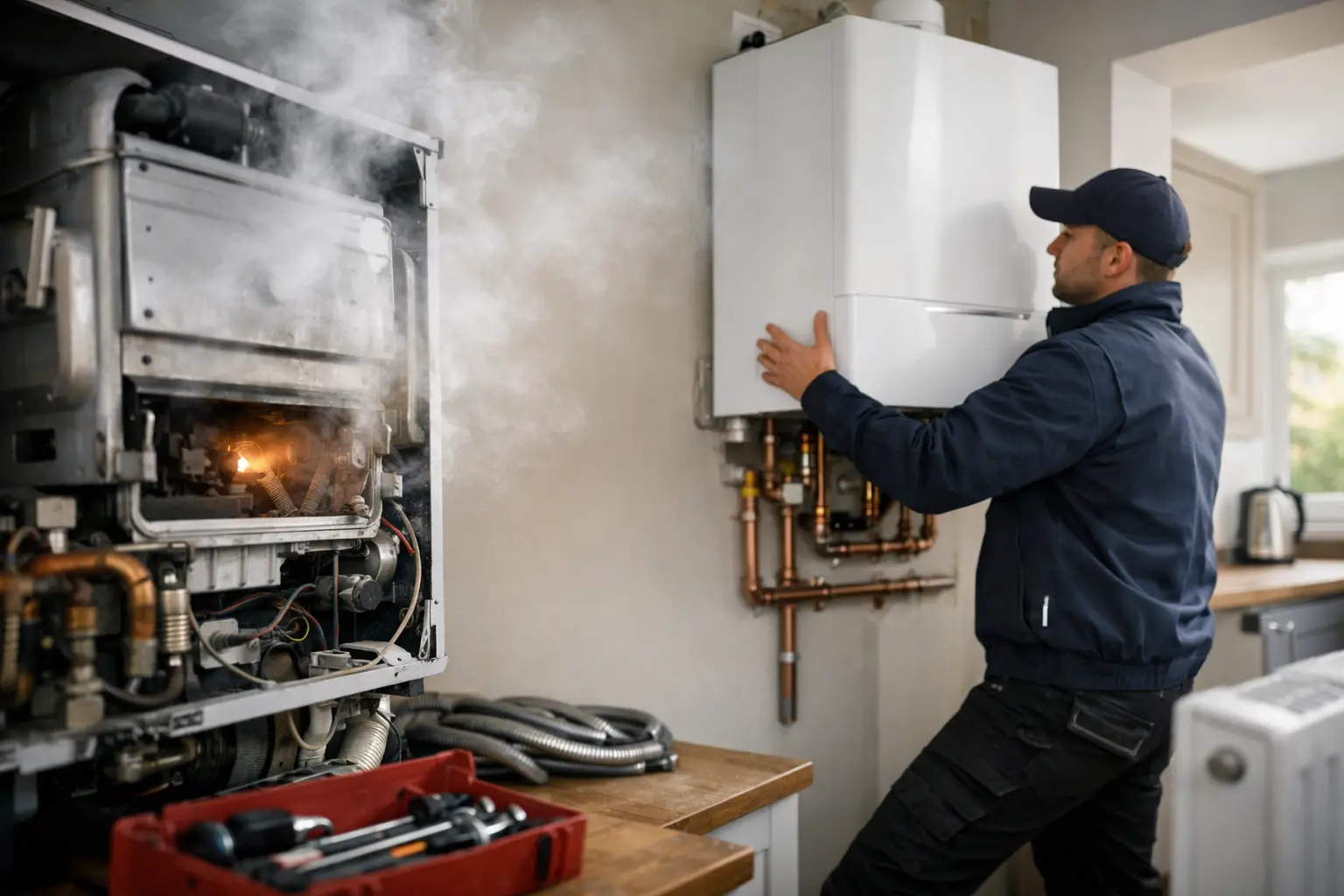
A broken boiler does not always mean an emergency boiler replacement is needed, but it does need a safe, prompt assessment. First rule out a gas or carbon-monoxide risk. If the appliance is safe but has failed, a Gas Safe registered engineer can advise whether repair or replacement is the sensible route.
Quick answer: make the property safe, do not remove the boiler casing or attempt a repair yourself, and arrange a professional diagnosis. Replacement is often the better option when a boiler is unsafe, beyond economical repair or repeatedly failing.
If you need a new boiler, get a fixed boiler quote online to compare suitable options for your home and understand what the installation is likely to involve.
When a boiler failure is a safety emergency
No heating or hot water is highly disruptive, particularly in winter or where there are children, older residents or vulnerable tenants in the property. It is not automatically a gas emergency, however. A boiler that has simply stopped working may have a fault that can be repaired.
Treat the situation as urgent from a safety perspective if you can smell gas, hear a hissing sound near gas pipework, notice soot or scorching around the boiler, or a carbon-monoxide alarm sounds. The guidance below applies to gas boilers.
| What you notice | What to do now | What happens next | | — | — | — | | Smell of gas or a suspected gas leak | Turn off the gas supply at the meter if it is safe to do so. Open doors and windows. Do not use electrical switches, naked flames or smoke. | Leave the area and call the National Gas Emergency Service on 0800 111 999. | | Carbon-monoxide alarm sounding | Turn off the appliance if you can do so safely, open windows and doors, and move outside into fresh air. | Seek urgent medical help if anyone feels unwell. Arrange for a Gas Safe registered engineer to inspect the appliance before it is used again. | | No gas smell or alarm, but no heating or hot water | Check the boiler display, pressure gauge and thermostat without removing any covers. Check whether there is a wider power cut. | Book a qualified engineer to diagnose the fault and discuss repair or replacement. |
Symptoms linked with carbon monoxide can include headache, dizziness, nausea, breathlessness, collapse and confusion. Do not assume a faulty alarm is the cause. The Health and Safety Executive and Gas Safe Register both stress the need to stop using a suspected unsafe appliance until it has been checked.
Is repair or emergency boiler replacement better?
The right decision depends on the fault, the boiler’s age, the availability of parts and the condition of the wider heating system. A straightforward issue such as low system pressure, a failed sensor or a faulty diverter valve may be worth repairing, especially on a relatively modern boiler that has otherwise been reliable.
Replacement becomes more compelling where the boiler has a serious fault, is no longer supported by readily available parts, has suffered several breakdowns, or has been condemned as unsafe. Repeated call-outs can quickly become poor value, while an older boiler may leave you without heating again at the least convenient time.
A good assessment should not begin with a one-size-fits-all recommendation. The engineer needs to consider how many bathrooms the home has, the number of radiators, existing pipework, water pressure and whether the current boiler type still suits the household.
For example, a like-for-like combi replacement is often the most direct option for a flat or smaller house with one bathroom. A home with higher hot-water demand may be better suited to a system boiler and cylinder. Keeping a regular heat-only boiler can also be practical where there is an existing tank-and-cylinder arrangement that works well for the property.
What happens during an urgent replacement
Fast, professional installation is possible when the replacement is straightforward and the right boiler is available. It is less predictable where the boiler is moving location, pipework needs altering, a flue route requires work, or the heating system needs substantial remedial attention. It is better to have this explained clearly than to be given an unrealistic installation promise.
1. The fault and safety position are checked
An appropriately qualified engineer establishes whether the boiler can be repaired and whether it is safe to remain connected. If it is unsafe, it should not be used while you wait for the next step.
2. Your home and hot-water needs are assessed
The quotation process should establish the present boiler type, controls, radiator system, flue position and likely access requirements. Clear photographs and accurate answers help with an online quotation, but some properties need a survey before the work can be confirmed.
3. You compare suitable replacement boilers
A replacement boiler is selected around demand rather than simply choosing the highest output. Oversizing can be unnecessary; undersizing can leave poor hot-water performance. Controls, warranty terms and the practicality of future servicing also matter.
4. Installation, testing and handover take place
The old appliance is removed, the new boiler is installed and the system is tested. The installer should explain the controls, confirm the paperwork you will receive and make clear any servicing or warranty-registration requirements. Keep these documents with the appliance records, particularly in a rental property.
What should an emergency boiler quotation cover?
A clear quotation is as important in an urgent situation as it is for a planned upgrade. It should identify the boiler and controls being supplied, installation labour, flue components, removal of the old boiler, commissioning and the warranty position. It should also state any assumptions made from the information available.
Some additional work cannot be confirmed until the property has been assessed. Examples include alterations to the flue route, condensate drainage changes, electrical work required for controls, upgrades to pipework, difficult access, repairs to the system or measures needed to meet current installation standards. These are not reasons to avoid an online quote. They are reasons for the quote to be specific about what is included and what may need further approval.
Smart Adapt is designed to give homeowners and landlords a straightforward online route to compare suitable boilers and arrange installation. Where applicable, an initial £250 deposit is taken, with the remaining balance payable after installation under the agreed terms. Finance options may be available, subject to status and eligibility.
Keeping disruption manageable
If your home is without heating, ask early about likely availability rather than relying on a general timeframe. You may need to make temporary arrangements for hot water, particularly if you have young children or a household member with a health condition. Do not use portable gas cookers, ovens or unvented heaters as a substitute for central heating.
Before the installer arrives, make a clear route to the boiler, airing cupboard or cylinder, move valuables away from the work area and ensure someone can provide access. If you are a landlord, keep your tenant updated about the visit and retain all safety and installation records.
For landlords, the duty to keep gas appliances, pipework and flues safe does not disappear when an appliance fails unexpectedly. Annual gas safety checks remain necessary, and any boiler or appliance identified as unsafe must be dealt with appropriately by a Gas Safe registered engineer.
Emergency boiler replacement FAQs
Can I keep using a boiler that is making unusual noises?
A banging, whistling or gurgling boiler may be suffering from circulation, pressure or internal component issues. Switch it off and seek advice if the noise is severe, new or accompanied by a smell of gas, a warning light, leaks, soot or an alarm. Never remove the casing to investigate.
Can a boiler be replaced without changing the radiators?
Often, yes. Existing radiators can remain if they are in good working order and suitable for the system. The installer may recommend cleaning the system, adding protection or making targeted repairs if sludge, leaks or poor circulation could affect the new boiler.
How long will the new boiler warranty last?
Warranty length varies by manufacturer, model and the terms in place when the boiler is purchased. It can also depend on correct installation, registration and ongoing servicing. Check the exact warranty offered for the chosen model rather than relying on a general headline figure.
When the boiler fails, the immediate goal is not simply to get any replacement fitted. It is to restore safe, dependable heating with a boiler that fits the property and a quotation that explains the work properly. Get a fixed boiler quote online, then move forward with clear prices and straightforward installation.