






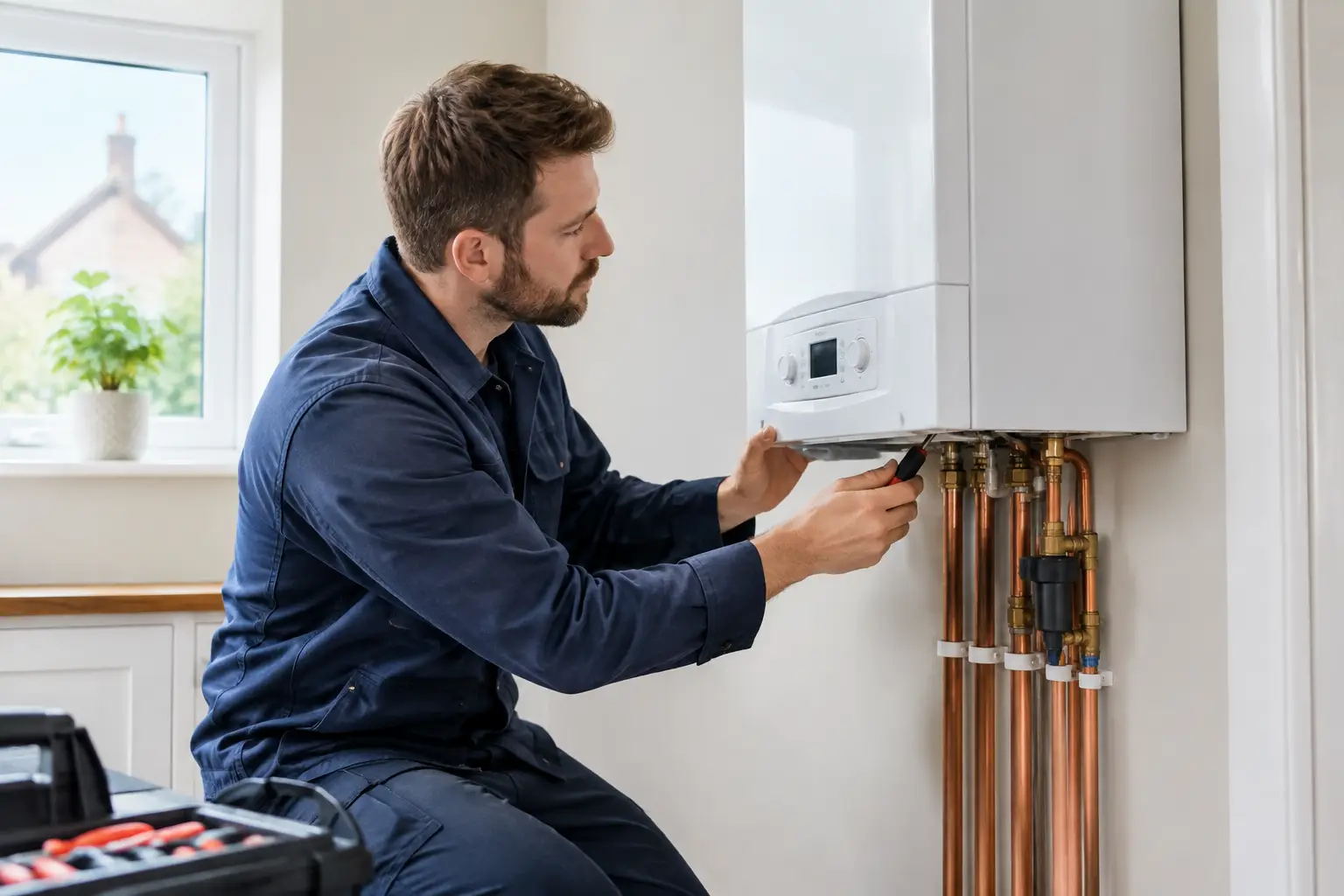
The right boiler output is the one that meets your home’s heating and hot-water demand without being unnecessarily large. This boiler output sizing guide explains what the kilowatt rating means, why combi boilers are sized differently and what an installer needs to check before recommending a model.
Quick answer: heating output should be based on the property’s heat loss, radiator requirements, insulation and layout. For a combi boiler, the hot-water output often drives the model choice, particularly where more than one shower may be used. A larger kW figure is not automatically a better choice.
Get a fixed boiler quote online.
What boiler output means
Boiler output is measured in kilowatts, shown as kW. It tells you how much heat a boiler can provide at its maximum setting. That capacity is used in two different ways: heating rooms through radiators, and producing domestic hot water for taps and showers.
These demands are not the same. A modestly sized, well-insulated two-bedroom home may need relatively little heat for its radiators, yet the household may still want a strong shower flow. This is why many combi boilers have a hot-water rating that is higher than the heating output the property needs.
For example, a boiler described as 30 kW may provide a lower maximum output for central heating and a higher output when making hot water. The exact figures vary by model, so compare the manufacturer’s central-heating and domestic-hot-water specifications rather than relying on the product name alone.
Boiler output sizing guide: the checks that matter
A reliable recommendation starts with the property, not a one-size-fits-all rule based on bedroom numbers. Bedrooms offer a rough starting point, but they do not account for ceiling height, insulation, glazing, extensions or how much hot water people actually use.
An installer will usually consider the following factors:
- The number, size and type of radiators, plus whether any rooms are consistently difficult to heat.
- The home’s age, construction, insulation, windows, draughts and exposed walls.
- The number of bathrooms, showers and regular occupants.
- Whether hot water is needed at more than one outlet at the same time.
- The existing system type, including whether there is a hot-water cylinder or cold-water tank.
- Any planned changes, such as an extension, loft conversion or an additional bathroom.
A room-by-room heat-loss calculation is the most dependable way to establish the heating requirement, especially for larger, older or altered properties. It estimates how quickly each room loses heat on a cold day and allows the boiler and radiators to be matched properly.
This matters because simply matching the output of an old boiler can repeat an earlier mistake. Older boilers were often oversized, while a home may now have better insulation or different hot-water use.
Choosing the output for a combi boiler
Combi boilers supply heating and hot water from one unit, with no separate hot-water cylinder. Their heating output needs to suit the radiators and heat loss, but their hot-water performance is often the deciding factor.
For a flat or smaller house with one bathroom and ordinary shower use, a lower-output combi may be suitable. A family home with one bathroom plus an en-suite, or a household that regularly runs taps while someone showers, may need a boiler with a higher hot-water output. That does not mean two showers can always be supplied comfortably at once. A combi heats water as it is used, so simultaneous demand will divide the available flow.
Flow rate is therefore just as useful as kW when comparing combis. It is normally expressed in litres per minute at a stated temperature rise. Cold incoming mains water can be much cooler in winter, so real-life shower performance can vary.
Mains-water pressure and flow also need checking. A high-output combi cannot create a strong shower where the incoming mains supply is restricted. In that situation, retaining or moving to a cylinder-based system may be worth discussing rather than paying for output the property cannot use.
Sizing a system or regular boiler
A system boiler works with an unvented hot-water cylinder. A regular, or heat-only, boiler normally works with a cylinder and may also use tanks in the loft. Both can be a sensible choice for homes with greater hot-water demand, multiple bathrooms or an existing cylinder system that is still suitable.
Here, the boiler’s output is primarily selected for the heating load and for reheating the cylinder. The cylinder stores hot water, so households can use water from more than one outlet more easily than with a combi, provided the cylinder, controls and incoming water supply are appropriately specified.
The trade-off is space. You need room for the cylinder, and a regular boiler arrangement may have additional components. A combi conversion can free up space, but it is not always the best outcome for a busy household with two or more bathrooms.
Why an oversized boiler is not the safe option
It is understandable to think a bigger boiler gives more reassurance. In practice, an oversized boiler can spend more time turning on and off at low demand, known as cycling. That can reduce efficiency and place unnecessary strain on components.
Modern boilers can reduce their output to match demand, a feature called modulation. A model with a suitably low minimum output can be particularly useful in a smaller or well-insulated home, where the heating load is low for much of the year.
Undersizing has the opposite problem. On colder days, rooms may take too long to warm up or the boiler may struggle to maintain the chosen temperature. The goal is not the largest unit. It is a boiler with an appropriate maximum output and good modulation range for your home.
What can change the recommendation and price
A boiler replacement is not always like-for-like. The correct output may lead to a different boiler type, cylinder arrangement or location. These changes can affect the final installation cost as well as the work involved.
Possible additional costs can arise where a flue route needs changing, the boiler is being relocated, pipework needs altering, a condensate route needs extending, or a system requires changes to support a new boiler type. Replacing a back boiler, converting from regular to combi, or adding a cylinder-based system also needs a more detailed assessment.
A fixed quote should clearly set out what is included and highlight work that cannot be confirmed until property details, photographs or a survey have been reviewed. Smart Adapt’s online quotation process is designed to use those details to suggest suitable boiler options, with postcode coverage and installation suitability confirmed before an installation is accepted.
How to prepare for an accurate boiler quote
Start by noting how many bathrooms and showers are used, how often hot water is needed at the same time, and whether you want to keep a cylinder. Take clear photos of the existing boiler, its flue, nearby pipework, radiators and any tanks or cylinder. Mention any cold rooms, planned extensions and changes to the number of occupants.
It also helps to know whether you are replacing an unreliable boiler urgently or planning ahead. A straightforward replacement can be less disruptive than a conversion or relocation, but the right installation timescale depends on the property and the work required. The installation should be completed by a Gas Safe registered engineer.
Frequently asked questions
Is a 24 kW boiler enough for a three-bedroom house?
It can be, but bedroom count alone does not decide it. A well-insulated three-bedroom home with one bathroom may have a modest heating requirement. Check the boiler’s hot-water performance as well as its heating rating.
Does a higher kW boiler make radiators hotter?
Not necessarily. Radiator temperature is controlled by the heating system and boiler settings. A higher output mainly means the boiler has more maximum capacity available. Correct radiator sizing, controls and heat-loss assessment remain important.
Can a combi boiler run two showers at once?
Some higher-output combis can provide useful flow for concurrent use, but results depend on the model, shower type and mains-water flow. For frequent simultaneous use, a system boiler and cylinder may be more suitable.
Should I keep my regular boiler and cylinder?
If your home has several bathrooms or high hot-water demand, keeping a cylinder-based arrangement can make good sense. If space is limited and demand is modest, a combi conversion may be worth considering. The pipework, water supply and layout should be assessed first.
Will replacing my boiler require new radiators?
Not always. Existing radiators may be suitable, but they should be considered as part of the sizing process. If rooms are cold or the home has changed since the system was installed, some radiators may need attention during the replacement project.
Is finance available for a new boiler?
Finance options may be available for eligible customers, subject to status, affordability checks and lender approval. The available terms and monthly payments should be reviewed before you commit.
Choosing boiler output is about matching the equipment to how your household actually lives, not buying the largest number on the brochure. Get a fixed boiler quote online. Clear property details give the installer the best chance of recommending a boiler that feels right on a cold morning and during the busiest part of the day.