






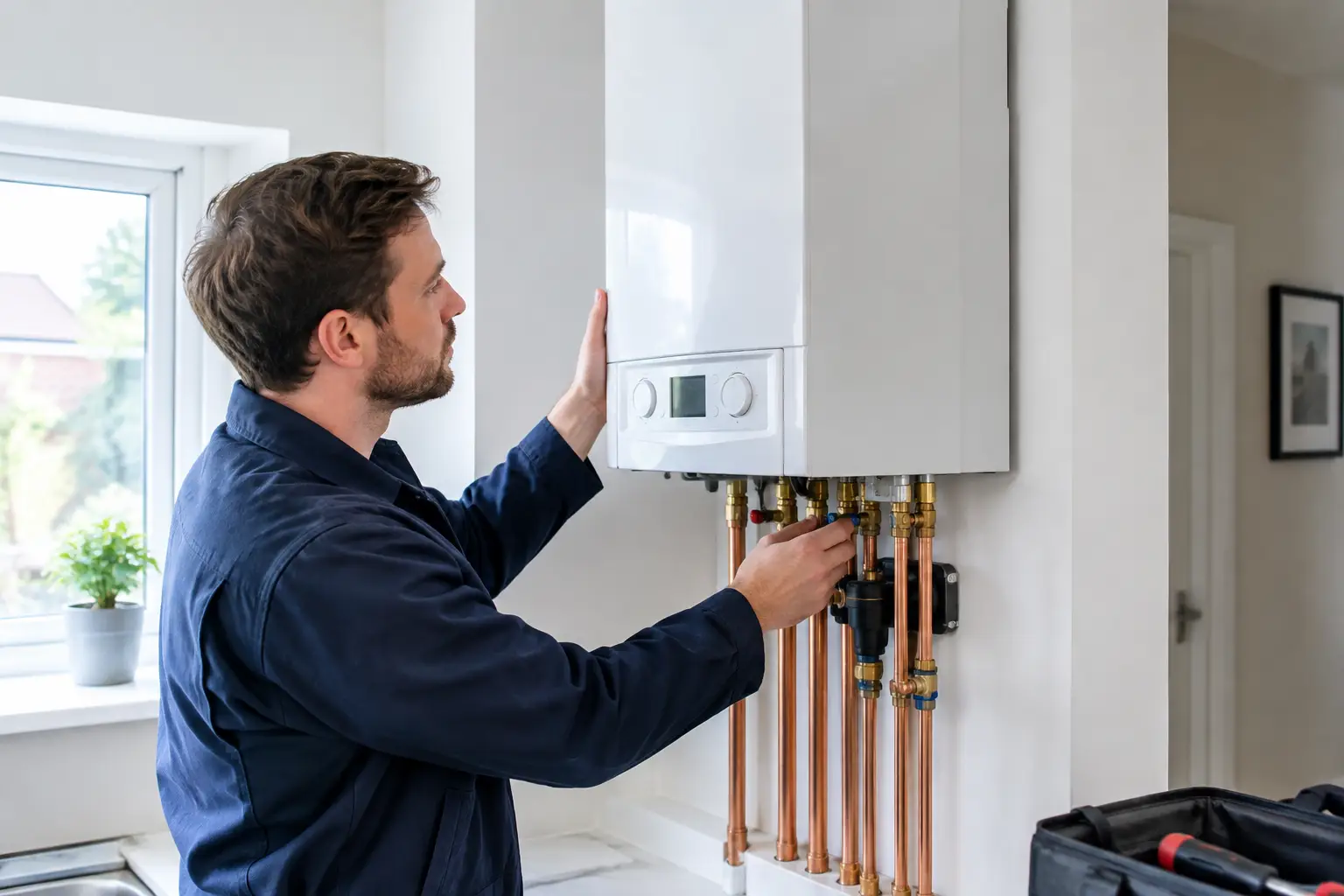
A correctly sized boiler has enough power to heat your home and provide the hot water you need, without paying for unnecessary capacity. To work out how to size a boiler, consider your property’s heat loss, number of radiators, bathrooms, occupants and the type of system already in place.
Get a fixed boiler quote online. Provide accurate property details and the quote journey can recommend suitable combi, system or regular boilers rather than relying on a one-size-fits-all answer.
Quick answer: what boiler size do you need?
Boiler size is measured in kilowatts (kW). It refers to output, not the physical dimensions of the unit. A larger home does not automatically need the highest kW boiler available.
For many UK homes, the central-heating demand is lower than people expect. A well-insulated two or three-bedroom home may have a heating requirement of around 5kW to 12kW on a cold day. However, combi boilers are often selected at 24kW to 35kW because they also need sufficient output to produce hot water quickly at the tap or shower.
As a broad starting point, a one-bathroom flat or house may suit a 24kW to 30kW combi, while a home with greater hot-water demand may need a 30kW to 35kW model. Homes with two bathrooms used at the same time often benefit from a system or regular boiler with a hot-water cylinder instead. These are starting points only, not a final specification.
Why boiler sizing is about more than bedrooms
Bedroom count is useful, but it is not enough to choose a replacement boiler. A compact four-bedroom house with one bathroom can have lower hot-water demand than a two-bedroom property with two powerful showers used at the same time.
The right output depends on how your household uses heating and hot water. An installer will look at the number and size of radiators, the property’s age and insulation, window area, layout, existing pipework, shower types and whether there is a cylinder or cold-water storage tank.
A proper assessment also checks practical details. These include the boiler location, flue route, condensate drainage, gas supply and whether a conversion or relocation is planned. They can affect suitability, installation work and the confirmed price.
Heating output: meeting the home’s heat loss
Every property loses heat through its walls, roof, windows, floors and ventilation. The colder it is outside, the harder the heating system has to work to maintain a comfortable indoor temperature.
A heat-loss calculation is the most reliable way to establish the output needed for space heating. It considers the rooms individually rather than making a guess based on floor area alone. This is particularly valuable for older properties, extensions, open-plan layouts and homes with mixed levels of insulation.
Radiator output matters too. If radiators are undersized or the system design needs attention, simply fitting a higher-output boiler will not necessarily make rooms warmer. The boiler and radiators must work as a system.
Hot-water output: usually the deciding factor for combis
A combi boiler heats hot water on demand. Its hot-water performance is often expressed as a flow rate in litres per minute, based on a stated temperature rise. A higher kW combi generally delivers a better flow rate, but incoming mains-water pressure and flow also have a major effect.
For one bathroom and normal kitchen use, a suitably specified combi can be an excellent space-saving choice. If two showers are likely to run together, a combi may struggle to provide the same experience as a cylinder-based system, even if the boiler has a high output.
This is where a system boiler can make more sense. It heats a stored volume of water in a cylinder, allowing several outlets to be supplied more comfortably when the cylinder and incoming water supply are correctly sized. A regular heat-only boiler may be appropriate where the home already has a traditional open-vented system with tanks, or where retaining that arrangement is the sensible option.
How to size a boiler by system type
Combi boilers
Choose a combi primarily around hot-water demand, then confirm it has more than enough output for the heating load. A 24kW to 30kW combi is commonly considered for homes with one bathroom and modest demand. A 30kW to 35kW model can suit larger homes or households wanting stronger hot-water performance from a single outlet.
The trade-off is simple: a higher-output combi can improve hot-water flow, but it does not overcome poor mains-water flow or make it ideal for several simultaneous showers. It may also cost more than a lower-output model.
System boilers
A system boiler is usually sized around the property’s heating requirement and the time needed to reheat the hot-water cylinder. It is often a practical choice for larger homes, homes with more than one bathroom and households with predictable high demand at busy times of day.
Cylinder capacity is as important as boiler output. A larger cylinder can store more hot water, but it needs room and must be suitable for the property’s water supply and household use. The best combination is based on demand, not simply choosing the largest boiler and cylinder available.
Regular boilers
Regular boilers, sometimes called conventional or heat-only boilers, work with a cylinder and often with tanks in the loft. They can be the most straightforward replacement when a home already has this arrangement and there is no strong reason to convert.
Converting to a combi can free up space, but it can involve removing tanks and a cylinder, altering pipework and checking that the mains supply is adequate. In some properties, retaining or replacing the regular system is the better-value and lower-disruption option.
Avoid these common boiler-sizing mistakes
The most common mistake is replacing like for like without checking whether the current boiler was ever correctly specified. An old 30kW boiler does not prove that a new 30kW boiler is right for the property.
It is also risky to choose solely from online kW guides. They are helpful for understanding the options, but they cannot assess heat loss, water flow, flue requirements or the condition and layout of the existing installation.
Oversizing can increase the initial purchase cost and may lead to more frequent cycling when heating demand is low. Undersizing can mean slower cylinder recovery, weaker hot-water performance or a home that takes too long to warm up. The aim is appropriate capacity and good control, not the biggest number on the product label.
What information is needed for an accurate recommendation?
An online quote can start with straightforward details about your home. Be ready to confirm the number of bedrooms, bathrooms and radiators; whether you have a bath; the current boiler type; where it is located; and whether you want it moved.
It also helps to explain how many people live in the property and whether showers are used at the same time. Clear photos of the current boiler, flue, controls, cylinder and any tanks can help identify work that may be needed before a fixed quote is confirmed.
Smart Adapt uses this information to match suitable replacement options to the home. Installation is carried out by Gas Safe registered engineers, subject to the property details, service-area availability and any survey or technical checks required.
How boiler size can affect your installation price
A larger-output boiler is not always much more expensive, but model choice can influence the overall cost. A system or regular boiler installation may involve a cylinder, controls and more pipework than a straightforward combi replacement. A conversion from a regular boiler to a combi, a back-boiler replacement or moving the boiler to a new location can add labour and materials.
A fixed quote should make clear what is included and flag foreseeable additional work. Possible extras vary by property and can include flue alterations, condensate work, system changes, access requirements or upgrades needed to complete the installation safely. Warranty length depends on the chosen boiler and the manufacturer’s current terms, including any registration requirements.
If you are considering monthly payments, available finance is subject to status, eligibility and lender approval. It should never be the reason to select a boiler that does not suit the property.
FAQs
Is a 30kW boiler too big for a three-bedroom house?
Not necessarily. For a combi boiler, 30kW may be chosen for hot-water performance rather than heating demand. It can suit a three-bedroom home with one bathroom, but the right answer depends on water flow, shower use and the home’s heat loss.
How many radiators can a 24kW boiler run?
There is no safe universal radiator limit. Radiator size, property insulation and heat loss matter more than the number alone. A calculation should confirm whether the boiler can meet the total heating load.
Should I choose a bigger combi boiler for better showers?
A higher-output combi can improve hot-water flow, but only where the incoming mains supply can support it. If several showers need to run together, a cylinder-based system may be more suitable.
Does a larger boiler use more gas?
Not automatically. Gas use is driven mainly by the heat and hot water your household needs. However, an incorrectly oversized boiler may cycle more often, which is one reason correct sizing and controls matter.
Can I replace a regular boiler with a combi boiler?
Often, yes. Whether it is worthwhile depends on mains-water flow, bathroom demand, the existing pipework and how much disruption you are willing to accept. A quotation should explain the conversion work clearly.
Can I size a boiler from my current model?
Your current model provides useful information, but it should not be the only basis for a replacement. Your household, insulation, bathroom use and system layout may have changed since it was installed.
How long does it take to confirm the right boiler size?
A suitable recommendation can often begin from accurate online answers and photographs. Some homes need a further survey or technical assessment before the boiler choice, installation work and fixed price can be confirmed.
Choosing a new boiler should feel like a considered home decision, not a guessing game. Get a fixed boiler quote online.