






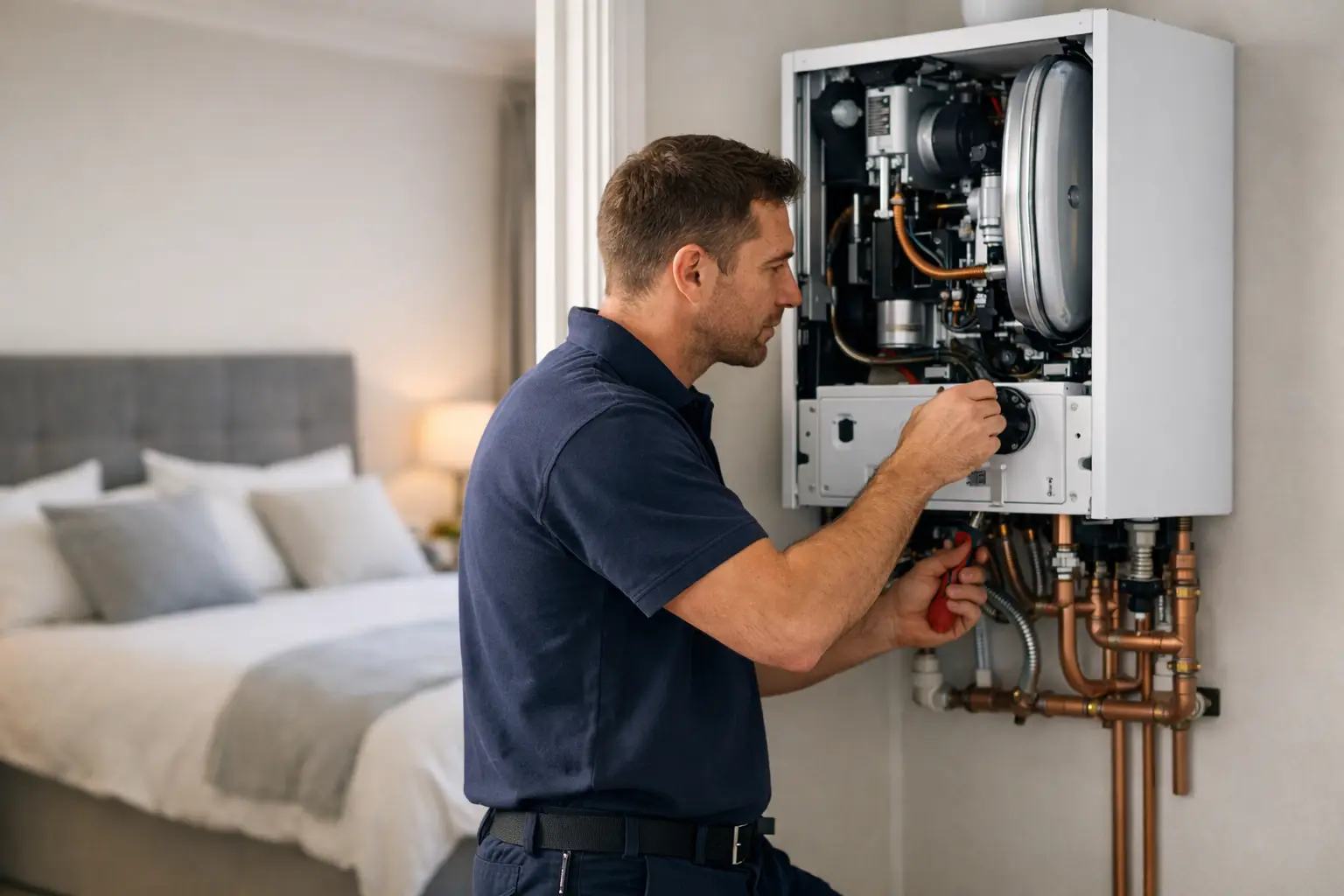
The best air conditioning for bedroom comfort is not a service Smart Adapt provides. But if you are searching because a bedroom feels cold, unevenly heated or slow to warm up, an ageing boiler may be part of the problem. A suitable replacement boiler can restore dependable central heating throughout the home.
Quick answer: a new boiler will not change the temperature of one room independently, but it can improve the reliability and consistency of your home’s heating when the existing boiler is unreliable, inefficient or no longer suited to demand. The right choice depends on your property, number of bathrooms, hot-water use and current heating system.
Get a fixed boiler quote online.
Best air conditioning for bedroom searches and cold bedrooms
A cold bedroom does not automatically mean the boiler needs replacing. Heat can be affected by radiator output, heating controls, insulation, pipework and the layout of the property. However, when the boiler is old, repeatedly losing reliability, or struggling to heat the home and provide hot water, replacement can be the more sensible long-term decision.
A replacement quote should consider the whole system rather than simply fitting the same output boiler again. A boiler that is too small may struggle at busy times, while an oversized model can cost more than necessary and may not be the right fit for a smaller home.
For homeowners and landlords, the useful question is: can the current heating system provide reliable warmth and hot water for the way the property is used? If the answer is no, a new boiler quotation gives you a clear basis for comparing options and costs.
Choose the boiler type before comparing brands
The most suitable boiler is determined primarily by the heating and hot-water system already in place. Brand and model matter, but a well-matched boiler type is the starting point.
Combi boilers for homes with no hot-water cylinder
A combi boiler provides central heating and hot water directly from the mains. It does not require a separate hot-water cylinder, which makes it a popular option for flats, smaller houses and properties with limited storage space.
For one bathroom and typical household hot-water demand, a combi can be a practical, compact choice. Its main limitation is that hot-water flow is shared. If several showers, taps or appliances need hot water at once, performance can be restricted by the incoming mains-water supply and the boiler’s hot-water output.
A move from a regular or system boiler to a combi can free up space, but it is a conversion rather than a straightforward replacement. Removing tanks or a cylinder, altering pipework and changing controls can increase the installation cost and duration.
System boilers for higher hot-water demand
A system boiler works with a separate hot-water cylinder. It is often suitable for larger homes, households with more than one bathroom, or properties where people regularly use hot water at the same time.
Because hot water is stored in the cylinder, two bathrooms can be served more comfortably than they often can with a standard combi arrangement. The trade-off is the need for cylinder space and the fact that the stored hot water must be reheated after significant use.
Regular boilers for traditional systems
Regular boilers, sometimes called heat-only boilers, work with a cylinder and usually a feed and expansion tank in the loft. They are commonly found in older properties with more traditional heating layouts.
Keeping a regular boiler arrangement may be the least disruptive approach where the existing system is in good order and there is a reason to retain the tanks and cylinder. In other homes, a system boiler or combi conversion may be worth considering, but suitability should be assessed from the actual property details.
What boiler output does your home need?
Boiler output is measured in kilowatts, or kW. It should be selected for the home’s heat loss and hot-water requirements, not simply its number of bedrooms. A well-insulated two-bedroom house and a draughty two-bedroom house can need very different levels of heating output.
For combi boilers, hot-water performance is equally important. A higher-output combi can improve shower flow where mains pressure and flow rate support it, but it will not fix a weak incoming water supply. For system and regular boilers, the cylinder size, recovery time and number of bathrooms are all part of the decision.
An accurate online quotation asks about the property, radiators, bathrooms, current boiler and hot-water setup. If the details suggest a more complex installation, a survey or technical assessment may be needed before the price and specification are confirmed.
What does a new boiler replacement cost?
A like-for-like boiler replacement in a straightforward location commonly costs around £2,000 to £4,500, including the boiler and professional installation. The final figure varies by boiler type, output, manufacturer, warranty level and the work required at the property.
A conversion from a regular boiler to a combi, a back-boiler replacement, or moving the boiler to a new location usually costs more. These projects can involve additional pipework, changes to the hot-water system, flue work, making good and electrical alterations associated with the boiler installation. A realistic budget can be several thousand pounds higher than a simple swap.
A fixed quote is different from an online estimate. It should explain what is included, such as the selected boiler, standard installation labour, flue components, controls and commissioning where applicable. It should also identify work that may cost extra if it is needed, rather than leaving you to discover it later.
What can affect the final installation price?
The boiler itself is only one part of the cost. The complexity of fitting it safely and correctly has a major effect on the final quote. Common factors include:
- changing boiler type, such as converting from a regular boiler to a combi
- relocating the boiler to another room, floor or cupboard
- replacing a back boiler and adapting the heating system
- upgrading controls or altering the flue route
- access constraints, specialist scaffolding or work needed to protect finishes
- system cleaning, pipework changes or radiator alterations where they are required for the installation
Not every property needs these items. The point of asking detailed questions during quotation is to reduce uncertainty before an installation date is arranged.
Installation times and what to expect
A straightforward like-for-like replacement can often be completed in a day, subject to the property and installation specification. More involved work, including conversions, relocations and back-boiler replacements, can take longer. The installer should confirm the expected programme once the work is understood.
On installation day, the old boiler is removed, the new appliance and flue are fitted, and the heating system is commissioned and tested. The engineer should explain the controls and provide the relevant handover information. Installation must be carried out by a Gas Safe registered engineer.
Manufacturers offer different warranty lengths across their boiler ranges. The available warranty depends on the exact product, the installation requirements and registration within the manufacturer’s stated timeframe. Check the terms attached to the specific boiler you are quoted for rather than relying on a headline warranty period.
When replacement may be the better option
There is no fixed age at which every boiler should be replaced. Some older boilers continue to operate, while others become difficult to rely on or no longer make financial sense to keep. Replacement is worth considering when breakdowns are becoming frequent, suitable parts are difficult to obtain, hot water is unreliable, or the boiler is no longer appropriate for the household’s needs.
For a landlord, the priority may be dependable heating and hot water with a clear installation plan for tenants. For a homeowner, it may be gaining better control, freeing up space through a conversion, or choosing a boiler that can serve an additional bathroom. The right answer is based on the property, not a one-size-fits-all recommendation.
Frequently asked questions
Can a new boiler make one bedroom warmer?
A new boiler can improve overall heating reliability, but it cannot independently control one bedroom unless the wider heating system and controls are designed to do so. The radiator, pipework, controls and heat loss in that room should also be considered.
Is a combi boiler suitable for a three-bedroom house?
It can be. Bedroom count alone does not decide suitability. A three-bedroom home with one bathroom may suit a combi well, while a home with multiple bathrooms and simultaneous hot-water use may be better served by a system or regular boiler with a cylinder.
How long does a boiler replacement take?
Many straightforward replacements take one day. Conversions, relocations and back-boiler replacements can take longer because there is more work involved. Your installation timescale should be confirmed as part of the quotation.
Will the quote include removal of my old boiler?
This should be clearly stated in the quotation. Ask what is included in the removal, installation, controls, flue components, commissioning and disposal, along with any work that may be priced separately.
Can I spread the cost of a new boiler?
Finance options may be available, subject to status, eligibility and lender approval. Check the representative terms, deposit requirements and total amount repayable before choosing a payment option.
Do I need a survey before accepting a quote?
Not every replacement requires a home survey. Where property details indicate a technical issue, complex installation or uncertainty over the existing setup, a survey may be needed to confirm suitability and final scope.
A comfortable home starts with heating you can depend on when you need it. If your current boiler is no longer delivering that confidence, compare suitable combi, system and regular boiler options based on your property and real hot-water demand. Get a fixed boiler quote online.