






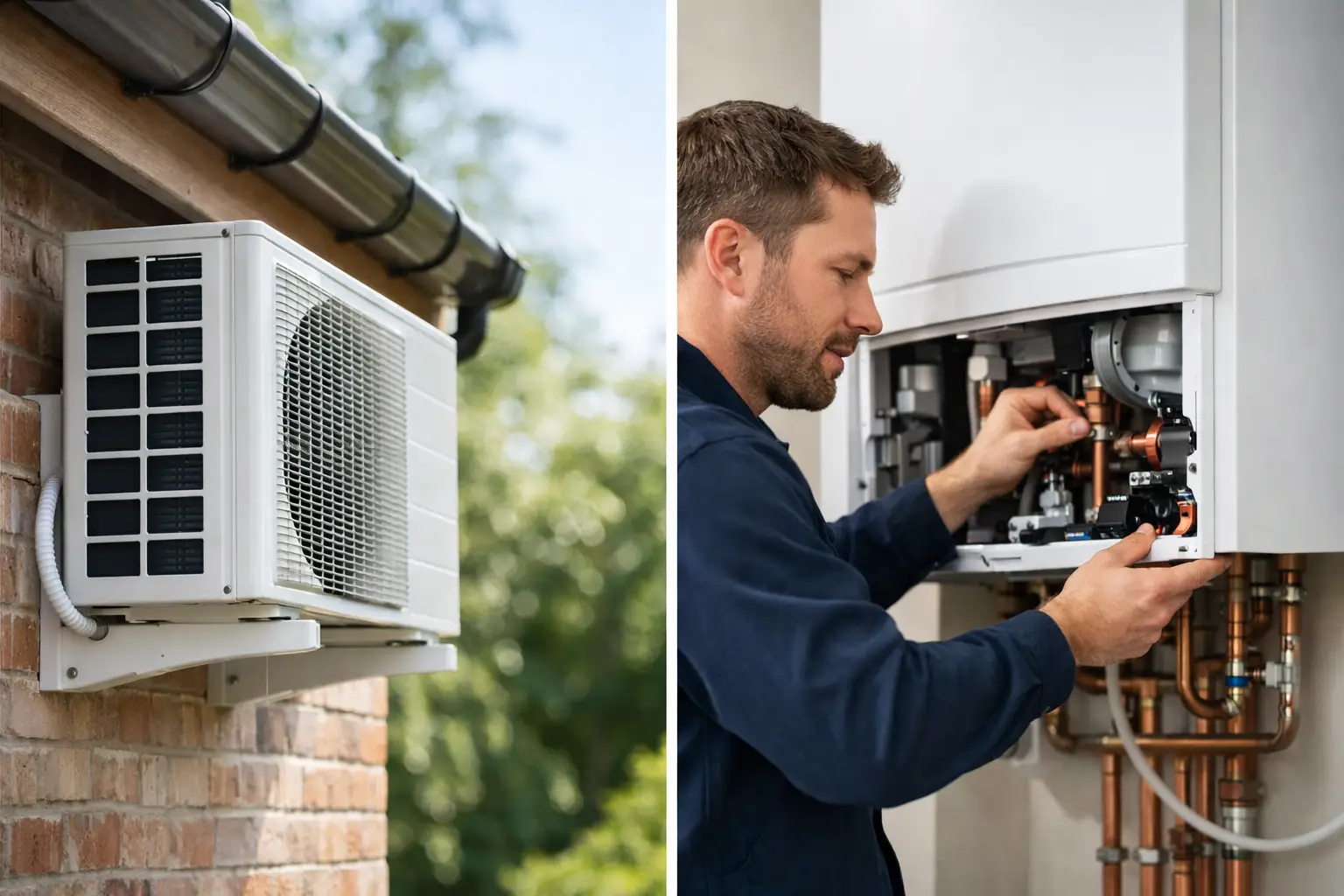
Air conditioning and a boiler solve different problems: one cools a room, while the other provides central heating and hot water. If your concern is unreliable heating, poor hot-water performance or an ageing boiler, the relevant solution is usually a boiler replacement. Get a fixed boiler quote online.
Smart Adapt focuses on supplying and installing replacement boilers for homeowners and residential landlords, rather than air-conditioning systems. That distinction matters, particularly when a property feels uncomfortable and it is not immediately clear whether the cause is the heating system, insulation, ventilation or something else.
Air conditioning is not a replacement for a boiler
A domestic boiler heats water. That heated water is sent to radiators and, depending on the system, taps, showers and baths. In most UK homes, it is the central part of the heating and hot-water system.
Air conditioning is designed primarily to cool and, in some cases, dehumidify indoor spaces. It does not provide the stored or on-demand domestic hot water that a boiler supplies, and it is not a like-for-like answer when an existing boiler is old, unreliable or no longer suitable for the household.
If you are comparing options because your home is cold in winter, radiators take too long to warm up, hot water is inconsistent or the boiler has become increasingly unreliable, start by looking at the boiler type, output and installation requirements. Replacing the right boiler can make the heating and hot-water system more dependable without changing the way the household uses it.
When a new boiler is likely to be the right question
A replacement boiler may be worth considering when the current appliance is approaching the end of its useful life, has become unreliable, or no longer meets the property’s demand for heating and hot water. A repair can sometimes be sensible, especially for a newer boiler with an isolated and economical issue. However, repeated faults, discontinued parts or rising repair costs can change the calculation.
Landlords may also need to consider reliability between tenancies and the practical impact of an unexpected loss of heating or hot water. For homeowners, the decision often comes down to confidence: whether it is reasonable to spend more on an old appliance or plan a replacement on their own terms.
The best replacement is not automatically the highest-output model or the boiler with the longest headline warranty. It needs to suit the home’s layout, radiator system, number of bathrooms and normal hot-water use.
Combi boilers for homes with typical hot-water demand
A combi boiler provides central heating and hot water from one compact unit. It does not usually need a separate hot-water cylinder or cold-water storage tank, which can free up space in a cupboard or loft.
For many flats, smaller houses and homes with one bathroom, a combi can be a practical choice. The key limitation is hot-water demand. A combi is generally most suitable where the household does not regularly need strong hot-water flow at several outlets at once. A larger combi may improve flow at one outlet, but it does not create the stored hot-water capacity of a cylinder system.
System boilers for higher demand
A system boiler works with a hot-water cylinder. It can be a better fit for larger homes, properties with more than one bathroom or households where showers and taps are often used at the same time.
The trade-off is space. You need room for the cylinder, and the existing system needs to be suitable or adapted accordingly. In return, stored hot water can offer a more comfortable experience at busy times of day when correctly designed for the property.
Regular boilers where the existing system supports one
Regular, also called heat-only, boilers are commonly found in properties with a separate hot-water cylinder and tanks in the loft. Keeping this arrangement can be sensible where it already suits the property and replacing it with another boiler type would add unnecessary alteration.
A conversion to a combi or system boiler can be possible, but it is not simply a boiler swap. Removing tanks, changing pipework, relocating equipment or altering the flue route can affect both the work involved and the final price.
What affects the cost of replacing a boiler?
A confirmed fixed quote should reflect accurate details about the property and proposed work. Online estimates can be useful for planning, but the final scope may need further checks where the installation is more complex.
The main cost is influenced by the boiler selected and whether it is a straightforward replacement in the same location. A like-for-like combi replacement is often simpler than converting from a regular boiler to a combi, moving the boiler to another room or replacing a back boiler.
Other factors that may affect the price include the condition and suitability of the existing pipework, the location and route of the flue, access to the installation area, controls, filter requirements and whether changes are needed to accommodate the new boiler safely. These are not hidden extras when identified properly – they are parts of the installation that should be explained before work is agreed.
For that reason, it is useful to provide clear property details when requesting a quote. The number of bedrooms and bathrooms, current boiler type, location, hot-water cylinder, flue position and any planned relocation all help determine what is suitable.
What a professional boiler installation involves
A boiler replacement is more than fitting a new appliance to the wall. The installer needs to remove the old boiler, fit the selected replacement, connect it safely to the heating and hot-water system, complete the required checks and explain how to use the controls.
Installation time depends on the job. A straightforward replacement may be completed more quickly than a conversion, relocation or back-boiler replacement. Work involving substantial changes to pipework, tanks or flue arrangements naturally needs more planning and may take longer.
The installation should be carried out by a Gas Safe registered engineer. The boiler must also be registered in line with the relevant requirements, and the homeowner should retain the installation documentation. Warranty length and terms vary by manufacturer and model. Registration deadlines, approved-product requirements and other conditions can apply, so it is worth checking the exact warranty for the boiler being quoted.
Choosing a boiler without guesswork
Start with how the property is used rather than the brand name alone. A one-bathroom flat with modest hot-water use has different needs from a family home where two showers may run at once. The existing boiler arrangement is also relevant: retaining a system that works for the home may offer better value than changing everything purely to follow a trend.
An accurate quotation process should make the choices clear. You should be able to see the proposed boiler type and model, what is included, what could cost extra if applicable, the warranty position and the next steps before accepting the work. There is no benefit in being pushed into a larger or more complicated system than the property needs.
Smart Adapt’s online quotation journey is designed to use property information to identify suitable boiler options. Postcode coverage, engineer availability, property suitability and any technical assessment still need to be confirmed before an installation is accepted.
Frequently asked questions
Can air conditioning heat my radiators and hot water?
No. A conventional central-heating boiler is designed to supply heated water to radiators and domestic hot-water outlets. If those are the parts of the home causing concern, assess the boiler system first.
Should I replace my boiler or pay for another repair?
It depends on the boiler’s age, reliability, repair history, availability of parts and the quoted repair cost. A newer boiler with a small issue may justify repair. An older boiler with repeated problems may make replacement the more practical long-term choice.
Which boiler is best for two bathrooms?
Many two-bathroom homes are better suited to a system or regular boiler with a correctly sized cylinder, particularly where hot water is used simultaneously. The right answer depends on household demand and the existing system.
Can I move my boiler to a different room?
Often, yes, subject to the new location being suitable. Relocation can increase the cost because pipework, condensate drainage, flue routing and access may all need to change.
How long does a boiler installation take?
A straightforward replacement is usually less involved than a conversion, relocation or back-boiler replacement. The expected timescale should be confirmed against the specific property and scope of work.
Is finance available for a new boiler?
Finance options may be available, but finance is subject to status, eligibility, lender terms and approval. Check the monthly cost, total amount repayable and agreement terms before deciding.
Do I need to be in the service area to request a quote?
Smart Adapt installs in selected areas of South Wales, the South West, London and nearby regions. Enter your postcode so coverage can be confirmed before a quotation or installation is accepted.
A comfortable home starts with a heating and hot-water system that matches the way you live. If your current boiler is no longer giving you that confidence, Get a fixed boiler quote online.