






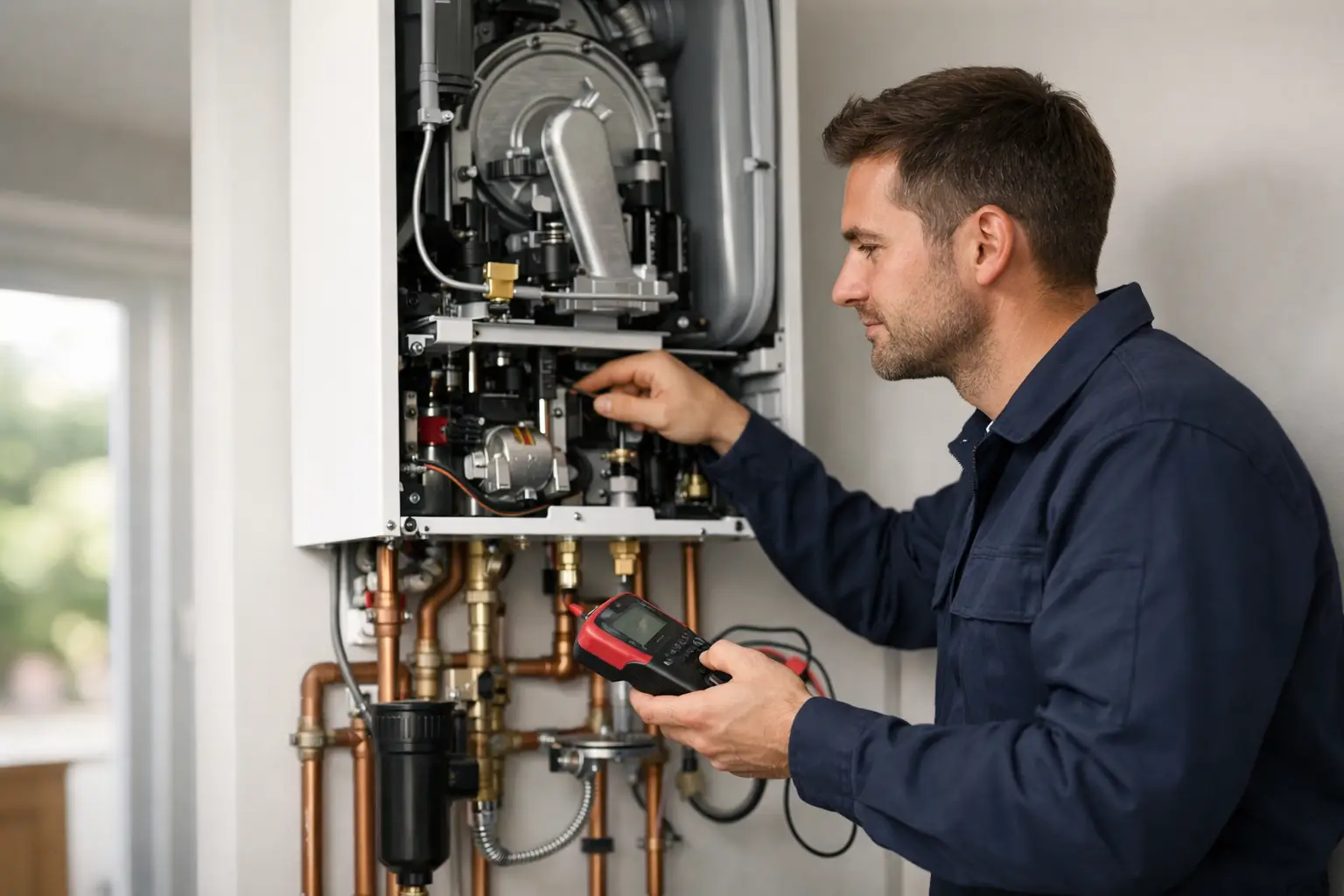
Landlord boiler replacement requirements do not normally mean replacing a boiler simply because it is old. However, landlords must keep gas appliances and flues safe, meet relevant energy-efficiency rules, and ensure any replacement is installed and certified correctly.
Quick answer: a new rental-property boiler should be suitable for the home’s heating and hot-water demand, installed by a Gas Safe registered engineer, notified under Building Regulations where required, and supported by the correct paperwork. The property must also continue to meet applicable EPC and tenancy standards.
Get a fixed boiler quote online.
When does a landlord have to replace a boiler?
There is no general UK rule stating that a landlord must replace a boiler after a set number of years. A reliable older boiler is not automatically unlawful just because a newer model may be more efficient.
Replacement becomes necessary when the existing boiler or flue cannot be kept safe, when it is beyond economical repair, or when it prevents the property from meeting its legal obligations. For example, a boiler with repeated major failures may leave tenants without dependable heating or hot water, while an inefficient system could contribute to an EPC problem.
Landlords also need to consider the practical cost of disruption. Replacing a boiler between tenancies is often simpler than arranging access during an occupied tenancy, particularly where a conversion, relocation or pipework changes are needed.
Landlord boiler replacement requirements for safety
The Gas Safety (Installation and Use) Regulations apply across Great Britain. Landlords must arrange an annual gas safety check for gas appliances and flues provided for tenants’ use. This check must be completed by a Gas Safe registered engineer.
A new boiler does not remove this ongoing responsibility. After installation, the boiler will still need to be included in the annual gas safety check at the appropriate time.
For a replacement installation, the key requirements are that the boiler, flue and associated gas work are installed safely and in line with the manufacturer’s instructions and current regulations. The installer must be appropriately registered for the work being completed. They should also provide the relevant installation documents and arrange Building Regulations notification where this applies.
Landlords must give new tenants a copy of the current gas safety record before they move in. Existing tenants must receive a copy within 28 days of the annual check. Keep installation certificates, the benchmark commissioning record and warranty information with the property file. These documents can make future safety checks, warranty claims and tenancy handovers far less complicated.
Carbon monoxide and smoke alarms
Alarm requirements differ between England, Wales and Scotland, and local licensing conditions may add further responsibilities for some rented properties. In England, private landlords must ensure carbon monoxide alarms are fitted in rooms used as living accommodation that contain a fixed combustion appliance, excluding gas cookers. Smoke alarm rules also apply.
A boiler replacement is a sensible time to check that alarms are correctly located, tested and recorded. Do not rely on the boiler installer to assess every wider tenancy requirement unless this has been specifically agreed.
EPC rules and older rental boilers
For most privately rented homes in England and Wales, the property needs an EPC rating of E or above unless a valid exemption applies. Scotland has separate requirements and planned standards, so landlords should check the rules that apply to the property’s location and tenancy.
An old boiler does not automatically mean a property fails its EPC. Equally, fitting a new boiler does not guarantee a particular EPC rating. The assessment considers the whole dwelling, including insulation, heating controls, windows and the heating system.
If an EPC is close to the minimum rating, replacing an older non-condensing boiler with a modern condensing model and suitable controls may improve the outcome. It is still worth reviewing the current EPC recommendations before committing to work, especially if the property has other factors holding its rating back.
Choosing the right replacement boiler for a rental property
The right boiler is based on the property, not simply the number of bedrooms. A two-bedroom flat with one bathroom and modest hot-water use may suit a combi boiler well. A larger house with two bathrooms used at the same time may need a system boiler with a hot-water cylinder. Some homes are best suited to retaining a regular heat-only boiler because of the existing system layout and cylinder arrangement.
Combi boilers
A combi boiler provides heating and hot water from one compact unit, without a separate hot-water cylinder. It is often a practical choice for flats and smaller rental homes with one bathroom. It can free up cupboard or airing-cupboard space and usually keeps replacement work straightforward when replacing an existing combi in the same position.
Its limitation is hot-water flow. A combi may not be the best fit where two showers are regularly used at once or where incoming mains water pressure is poor.
System and regular boilers
System boilers work with a hot-water cylinder and are often better suited to properties with higher hot-water demand. Regular boilers also use a cylinder and may suit homes with traditional open-vented systems, although the best option depends on the existing pipework, tanks and planned work.
Changing from a regular boiler to a combi can be worthwhile in some properties, but it is not always the lower-cost option. Removing tanks and cylinders, altering pipework, upgrading the gas supply or relocating the boiler can add time and cost.
What a compliant boiler replacement should include
A clear installation quotation should explain the boiler model, output, warranty length and the work included. For a straightforward like-for-like replacement, this commonly covers removal of the old boiler, installation of the new boiler, required controls, a system clean or protection measures where appropriate, commissioning and handover documentation.
The final scope depends on the survey or accurate property information. Possible additional costs can arise from a new flue route, scaffolding or access equipment, condensate pipework changes, difficult boiler access, gas-pipe upgrades, alterations to the heating system, asbestos concerns, or moving the boiler to another room.
Building Regulations requirements can also affect the design. In England, Boiler Plus requirements apply to most new gas boiler installations and require time and temperature controls plus an additional energy-efficiency measure. Requirements in Wales and Scotland are not identical, so the installation should be designed for the nation in which the property is located.
How much does a landlord boiler replacement cost?
As a broad guide, a straightforward supplied-and-installed boiler replacement may cost around £2,000 to £4,500. The price depends on the boiler type, output, manufacturer, controls, flue arrangement and the amount of installation work required.
A more involved project, such as a regular-to-combi conversion, back-boiler replacement, boiler relocation or work requiring significant alterations, can cost more. These installations may fall above £4,500 and sometimes considerably higher where access, system changes or remedial work are needed.
These are estimates, not fixed prices. A fixed quote should confirm exactly what is included, identify any assumptions, and explain what would happen if an unforeseen issue is found on site. For landlords, this clarity matters because an apparently cheaper quote can exclude necessary items such as flue work, controls or system alterations.
Installation timing and tenant access
Many like-for-like replacements can be completed in one day. Allow two or more days for conversions, relocations, back-boiler replacements or properties where the heating system needs wider alterations.
For an occupied property, give the tenant reasonable notice and agree access in writing. In England and Wales, landlords generally need to provide at least 24 hours’ written notice before entering, unless there is an emergency. Keep the tenant informed about any period without heating or hot water and arrange the installation at a practical time where possible.
A planned replacement can reduce avoidable disruption, but a vacant property is not always available. The installer should explain the likely timescale before work starts rather than promising an installation date that has not been confirmed.
Warranty, paperwork and responsibility
Manufacturer warranties vary by boiler model and usually depend on correct installation, commissioning and registration within the manufacturer’s stated period. A longer warranty is useful, but it should not be the only deciding factor. Suitability, output, hot-water performance and the quality of the installation are equally relevant.
Ask for the boiler’s warranty terms in writing and confirm who will register it. Keep the Gas Safe paperwork, Building Regulations compliance certificate, commissioning record and invoice together. If the property is managed by an agent, make sure both the landlord and agent hold copies.
Smart Adapt can provide a fixed online quotation for suitable replacement boilers in its confirmed service areas, with installation arranged by Gas Safe registered engineers. Entering the property details accurately helps identify whether the job is likely to be a straightforward replacement or needs further assessment.
Get a fixed boiler quote online. Finance options, where available, are subject to status, eligibility and lender approval.
FAQs
Does a landlord have to install a new boiler if the current one works?
Not solely because of its age. The boiler must be safe and the property must meet applicable legal standards. Replacement may be sensible if reliability, efficiency or compliance is becoming a problem.
Does every new landlord boiler need a Gas Safe certificate?
The boiler must be installed by a suitably Gas Safe registered engineer. Landlords should retain the installation and commissioning paperwork, alongside the annual gas safety record required for the tenancy.
Can a landlord install a combi boiler in any property?
No. A combi needs adequate mains-water flow and pressure, and it must meet the property’s hot-water demand. A system or regular boiler may be more suitable for larger homes or multiple bathrooms.
Will replacing a boiler improve an EPC rating?
It may help, particularly where a property has an older inefficient boiler. It cannot guarantee a rating because the EPC assesses the property as a whole.
How long does a landlord boiler replacement take?
A straightforward like-for-like change is often completed in one day. Relocations, conversions and back-boiler replacements usually take longer.
Can the cost be spread with finance?
Finance may be available for eligible customers, subject to status, lender terms and approval. Check the total amount repayable and the agreement terms before proceeding.
Who is responsible for arranging access to a rented property?
The landlord remains responsible for meeting legal obligations, even where an agent manages the tenancy. Agree access with the tenant, provide appropriate notice and retain a record of communication.
A well-planned boiler replacement is not just a response to a breakdown. It is a chance to give tenants dependable heating, keep property records in order and choose a system that suits the home for the years ahead.